Unringing the bell: Researcher works to understand, heal the brain following concussions
Download MP3Intro: In a recent preseason NFL game against the Atlanta Falcons, Detroit Lions safety Morice Norris Jr. was taken off the field via ambulance after being knocked unconscious during a play. Reports said his head was “snapped back” after assisting on a tackle.
The injury was so concerning that members of both teams held hands in a circle on the field immediately after Norris’ injury, and each of the respective coaches agreed not to finish the game.
Norris is reportedly doing well now, but for the next few weeks is on what’s known as “concussion protocol,” which outlines the steps for managing and recovering from a traumatic brain injury. And while Norris’ case is at the more extreme end of occurrences where the protocol is used, the football field is far from the only place where knowing what to do following a concussion can be critical.
Colorado State University Associate Professor Jaclyn Stephens is the director of the College of Health and Human Sciences BRAINSTORM Lab, where she studies adults with sports-related concussion along with more severe forms of acquired brain injury.
Stephens’ research focuses on understanding how the brain is affected by injury, developing new ways to evaluate concussions and the recovery process, and partnering with rehabilitation specialists to support safe and successful returns to everyday life, including sports, work and school.
Today, I’m speaking with Stephens to learn more about the short and long-term impacts of concussion, what we’re learning about concussion recovery, and how yoga might play a key role in rewiring the brain.
Host: What is a concussion? What happens in the brain when you suffer a concussion?
Stephens: Very simply, you have a blow to the head or body that causes rapid acceleration or deceleration of the brain inside the skull. And then there’s a pretty quick onset of symptomology. For the most part, if people go to the ER, their CT or MRI scans will come back negative. It’s still important for people to go to the ER because you can have head impacts that cause bleeding that can be very, very dangerous if not fatal because you have a skull around your brain, so if it’s bleeding and swelling and then it starts to get stuck inside of its confined bone space, you can have compression of things like the brainstem, and then people stop breathing. You want to rule out things like brain bleeds and swelling and things like that.
Often people will go to the ER, and they will say the CT or MRI is normal. That is often another hallmark of a mild traumatic brain injury. Typically, you’ll see people that have had loss of consciousness or the absence of loss of consciousness. It’s not required that you have a loss of consciousness, but it’s typically under 30 minutes. You may have things like post-traumatic amnesia where you don’t remember what happened around the event. Those are pretty common.
But if you are watching — not to pick on football, but we see a lot of concussions in football; that is a known thing — if you see a football game and you see somebody who gets hit and it appears that they hit their head really hard, or their body gets hit and their head snaps back and forth, and then they get up and they’re dazed and they’re wobbly, they don’t look steady on their feet. Those are some pretty good indicators that someone has sustained a concussion.
We have lots of diagnostic tools, including the concussion recognition tool, which can be used by just about anybody. If you think you saw a concussion, you want to err on the side of caution and remove the person from the activity. That is probably the most important thing I can say today is if you think it’s a concussion, remove them, have somebody who’s very qualified evaluate them. If you’re wrong, it’s probably not going to have a big negative consequence. If you’re right, you may have saved them from getting another injury, which can have catastrophic consequences. I think it’s really important for people to, when in doubt, suggest removal from play and then get an evaluation by somebody who knows a little bit more about the injury.
Host: I think we’ve all seen that moment where you see someone get up after a fall or being hit and they shake their head. You can tell they’ve really had their bell rung.
Stephens: Yeah, “getting your bell rung” is one of those expressions that was used to minimize a concussion, and it’s an expression that’s still being used. Some people do just get hit and they’re okay because maybe the impact was absorbed by other parts of their body. But there are really clear diagnostic criteria now for saying the blow and the onset of some of these symptoms are more than just this “Oh, just shake it off” kind of situation. You need to remove that person from play.
Host: Let’s talk specifically about your research looking at how the brain responds after a concussion and then later during return-to-play following a concussion.
Stephens: It’s really interesting because we have pretty good ways of diagnosing concussion. Like anything, there’s still a need for enhanced procedures. We’re pretty good at diagnosing it. Then we have a lot of gold standard procedures for getting people back to play after they’ve had a concussion. Those across the board globally are not always followed, but lots of places, like CSU Athletics, do a great job following these kinds of protocols.
But even when people followed the gold standard of return-to-play, researchers were able to detect deficits in “dual tasking,” when people try to do two things at the same time. And if you think about athletes, they’re constantly doing multiple things at a time when they’re practicing and when they are in game play. We were just really interested in figuring out why. Why are they still showing some deficits in this very fundamental component of how they perform sports after they’ve returned to play?
A lot of the work had been done in a behavioral space. I’m trained as a cognitive neuroscientist as well as an occupational therapist. I was very interested in understanding why we were seeing these things behaviorally. You could see motor performance or cognitive performance get a little bit worse, but I was really wanting to understand what the neural underpinnings, so what was happening in the brain that was causing these kinds of interesting patterns of behavioral performance.
While I was a postdoc, I actually developed a measure called the dual-task screen. Dr. David Howell has done a ton of work, still does a lot of work in concussion space, but he had been doing a lot of work in the dual-task space, all these behavioral assessments. At that time, a lot of the assessments that he was using were really fantastic and they were using really expensive motion capture systems and things that we only have in laboratories.
I developed a measure called a dual-task screen so that we could acquire the same information but with low-cost items in a quick way. The initial development of this task used tennis balls, yoga blocks, and a stopwatch and could be completed in about 10 minutes. Many clinicians only have 10 to 15 minutes to see a client. If they wanted to try to elicit some of these dual-task deficits after concussion, we might be able to work within that space.
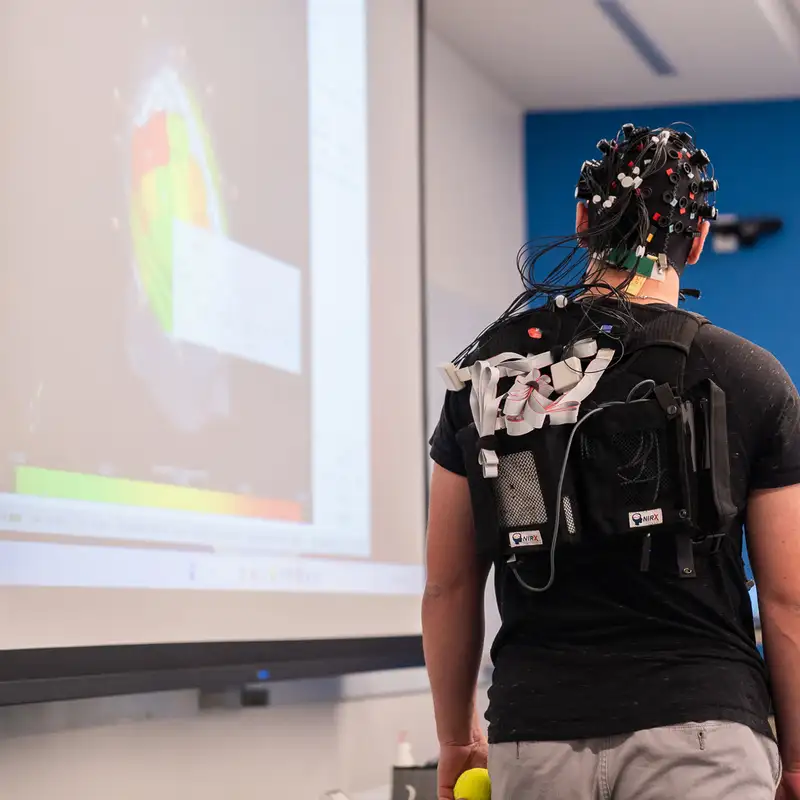
My research has continued in this trajectory using the dual-task screen. It has evolved where I have now made it much, much longer and much more complicated, so I can also get neuroimaging data with it, so it serves a different purpose. It still has the ability to be administered in 10 minutes, but when I add the neuroimaging, I can actually see the neural underpinnings of when people do just a single task, like a motor task where they’re just walking, or a cognitive task where they’re coming up with as many words as they can that start with a particular letter, and then the dual task where we combine those two, and then we can actually look for deficits elicited in that dual task condition in the motor domain, so they walk more slowly, or in the cognitive domain where they generate fewer words. I can see how much brain activity it takes to do just one of the tasks, how much it is when they do both of the tasks, and if there’s differences when people have had a concussion. We study both healthy athletes and we study people with concussion.
Host: One of the things I found interesting was that when they’re doing that task, it’s not that they can’t do it, or as well, necessarily, but it’s that the brain is working in a different way. Am I explaining that right?
Stephens: You’re right. What we’ve been finding that has been really interesting is that for our concussion cohort, they tend to walk as quickly as never-injured peers, and they generate as many words. We also have another subcomponent of the task where they throw and catch a tennis ball, because I was thinking hand-eye coordination is an important skill for athletes. Then they do serial seven subtractions, which is not intentionally mean, but people think it’s mean. But they’re subtracting backwards by seven until failure, or until the 30 seconds is up.
We’re seeing that when they were doing just the walking or just the throwing and catching or just subtracting or just word generation, their performance was nearly identical to people who had never sustained a concussion. But when I looked at their brain data, their brains were working harder. We were seeing a lot more neural activity across the board, across all the regions that we were measuring from when we were doing those simpler single tasks.
This suggested to me that there was maybe some compensatory brain activity to support easier task performance. It aligns with the subjective experience people with concussion have, where they say, “I’m just so tired at the end of the day.” Proportionately, they’re using much more energy and effort to execute the same task. So of course, by the end of the day, they’re going to feel exhausted. I think it was a helpful piece of information for us to find and be able to document. It also has made us curious about some of the long-term impacts of concussion on brain health.
Host: So, what does that tell you?
Stephens: It suggests neural inefficiency. I’m exploring an avenue of inquiry because what’s so interesting is that these patterns of neural inefficiency also appear in aging. On the other side of the scientific literature, they’re saying, when people have had head injuries of any severity type, they’re more susceptible to neurodegenerative diseases like Alzheimer’s.
The number one cause of Alzheimer’s disease is aging, just getting older. If we’re seeing neural inefficiency patterns that resemble that of aging, it’s possible that we’re seeing this pattern of accelerated brain aging after people have sustained concussion. I really want to emphasize that I don’t want to be an alarmist. Just because I see patterns of this does not mean it’s happening in everybody. In fact, when I look at all of the data I acquire from people with concussions, many of them look very much like their never-injured peers.
The reason that we see group differences is there’s just a few people that really look atypical. Where science is going next is trying to figure out who those people are, what the risk factors are. If any of those risk factors are modifiable. We can’t modify someone’s age or sex. We have to think about what are the things that we can modify? How much exercise are they getting? What does their nutrition look like? Things that we can change. It could be that we could identify who those folks are and then really understand them better and then try to get them back into both behavioral and neural patterns that resemble that of young adults rather than potentially resembling an older adult cohort.
Host: This can be really a hot button topic, especially with the NFL and those conversations. What are some of the biggest misconceptions that people have about concussions and maybe also about the people that study concussions?
Stephens: One of the biggest misconceptions or what comes up a lot is, “Oh, you just want to cancel football.” I don’t think we want to cancel football. There are some scientists out there that believe the risk is too high for people. I’m not one of those scientists. I’m not trying to shut anything down or cancel anything. I’m in the Department of Health and Exercise Science. I think, ultimately, athletics and sports and any sort of recreation participation is good for us. Does exercise come with some risk? Yes. So does not exercising. It comes with lots of documented risks. The misconception is often that we’re trying to cancel things or change things or interfere.
I think it’s also important to note that I’m a researcher. I have a clinical degree, but I do not practice clinically at CSU in a concussion space. When I am collecting information about athletes who have had concussions, that is private information. I don’t share it with their coaches. I don’t share it with their parents. I don’t share it with anybody. They can see their own information, but all our protocols are approved by the Institutional Review Board. We have privacy and confidentiality rules, and they get complicated and nuanced, but I am not sending this information to coaches and saying that I see something wrong with their player. That’s absolutely never going to happen. That information is not going to leave the lab and we’re really describing things at a group level. That’s why I’m saying at a group level, they all look a little different. I can tell that it’s driven by a few individuals, but that is not coming out in the way that we disseminate our findings.
As for misconceptions about concussion, there’s a few of them. There’s the one side of things where more people will say, it’s just a concussion, and I was just at a brain injury conference, and we’re really, as a collective, trying to get away from this mild term. It’s such a misnomer because for some people, it really is something that they recover from in like seven to 10 days and they feel fine. For other people, they will have issues and things that go on and they will tell me six months later, I still just don’t feel like myself. We’re really trying to validate that experience for many people, so we need some better terminology. It’s not just a concussion, it is a traumatic brain injury and hopefully we’ll have some better language and terminology around it to help people really get the care that they need after they’ve sustained an injury, especially if they’re having residual issues from it.
The other side is the way that people approach concussion care. There was, for such a long time, a practice of cocooning. You get a concussion, and you go into a dark, quiet room, and you don’t do anything. Research is showing that those are really terrible approaches. We know that people who are told that they cannot do anything tend to become more symptomatic. There have been protocols where we thought rest was the right thing. That was the active intervention and the people who didn’t follow the intervention got better faster than the people who were adherent to the rest protocol.
Really the best practice is to avoid screens for the first 48 to 72 hours but start to engage in physical activity as soon as you feel able to. It’s not about avoiding all activity just because you have symptoms but really monitoring those symptoms. If they’re not getting a lot worse, then you can keep doing the activity. That’s going to facilitate some of the healing and recovering a lot more than we previously thought.
That’s what I’m frequently trying to communicate to people if I’m asked. Your kid got a concussion. I’m so sorry that it happened. Let’s take the phone away for a little bit. Then if they feel up for going for a walk, go for a walk. A little bit of stretching, some yoga, stuff like that where there’s a very minimal risk of another head injury. Bike riding could be a little dangerous because you have to balance and if you get going too fast. But really movement where there is not a likelihood that you’re going to hit your head is really helpful for concussion recovery.
Host: You mentioned yoga, now I know you have a study that you’re working on right now that incorporates yoga.
Stephens: Every time we study yoga, we look at balance outcomes because there’s lots of things that people that have had brain injury experience, but balance is one of those things that can really restrict your participation because you don’t feel steady on your feet to leave the house, navigating curbs, getting in and out of places. It really can feel overwhelming and daunting to try to engage in the community.
Often people that have balance impairments, they’re more susceptible to falls and they tend to have lower quality of life. We can make a big impact by targeting balance with yoga. Everything that we’ve published so far has shown that yoga improves balance. Fortunately, we also found that an adaptive exercise program that was developed by Dr. Heather Leach in Health and Exercise Science was also good for improving balance in folks with brain injury.
If you were a pure yoga enthusiast, you’d be like, “Oh man, I wish yoga had done more.” But as a clinician, as a therapist, it means that we have options. We can tell people, we’ve got yoga, we’ve got adaptive exercise.
What is so fascinating is that during the study, everybody’s balance got better regardless of if they were in the yoga group or the exercise group, but their brain imaging, the neural recruitment patterns that we saw during balance were different depending on which group they were in. Everybody’s balance got better, but it got better from different underlying mechanisms. It’s been a really cool merger of something that is quite clinically oriented, and we’ve literally had people tell us this has changed my life.
Host: That’s amazing.
Stephens: We had one of our participants who was able to open her hand after a stroke. I say “brain injury” broadly, so this was an acquired brain injury in this case. After she started yoga, she was able to open her hand after like 30 years of it being in a contracted position. It was remarkable. We have these kinds of clinically relevant findings, and we have all the neuroscience findings and then we keep hearing these stories from people telling us how important these exercise programs and just getting into the community with other people that have experienced something similar.
Dr. Jen Weaver, who’s an assistant professor in occupational therapy, has been involved in some qualitative data acquisition in part of these studies and really thinking about what’s the next steps for implementing these kinds of exercise or yoga groups or activities for folks and are there ways that we or other scientists, clinicians, et cetera, can make these sustainable programs that we provide for people. Because as much as we know that exercise is so good for people, if you’ve had a brain injury, you can’t easily go to a yoga class at a yoga studio and expect that they’re going to know how to help you and modify you and position you to be able to have a successful experience in that class.
These adaptive programs are really designed to support participation at any level. We’ve had folks that have been in wheelchairs to people who don’t use any sort of mobility device for ambulation, but we can grade the activities to make it easier or harder for people as they need it.
Host: When you approach your research, you have a lot of lenses that you’re looking through. You have occupational therapy, psychology, neuroscience, and also, as a former athlete, I believe you were an athlete in high school, college?
Stephens: Yeah, I played volleyball all through junior high and high school, and then I was on a club team in college and a little bit of softball.
Host: How do all of those lenses work together with your current research?
Stephens: There are pros and cons to having interdisciplinary training and interdisciplinary lenses. At times, I feel like a dilettante in all things. Like, I don’t know anything about anything because I’ve gone on too many paths. But at other times, I feel it’s given me this unique understanding of when somebody gets injured and can’t play their sport, I can empathize with this.
As a former athlete who had lots of orthopedic issues and watched my teammates lose games after I got pulled because the injury that I sustained not only took me out of the game. I wasn’t that great of a player, but it was traumatic and disruptive to the flow of play and then it was just so frustrating. To lose opportunities to practice with my team and play with my team and be really frustrated with my body and its limitations. I can totally understand that.
When you define yourself as an athlete, but you’re not at practices and games, you kind of feel like, “Am I still an athlete?” That kind of aligns very closely with what occupational therapy thinks about as we think about people’s roles. Their identity and how our occupations, like sports, when we’re taken from our occupations, it has an impact on our roles and identity.
Then if we think about in the field of psychology, and I’m not a clinical psychologist, but I have some collaborations with them, we know that when people are removed from these things, they have higher prevalences of anxiety and depression. Our psychology and OT colleagues are very aware of the ramifications for these types of injuries. We think about mental health and physical health and cognitive health and everything that goes into doing an occupation. All of the components that go into that are supported by brain health and brain activity. We can get some really clear insights into why something isn’t working as well as it should be.
Our dual task research has really helped us understand why these dual task deficits are happening. It also allows us to look at things like, okay, if we make things better, what has changed that made things better? It can allow us to have more targeted interventions and considerations about what we think needs to be the next step. Any one of these approaches can give us a really fantastic insight into what’s next.
Host: Thank you so much for being here and talking about this important topic, but also this incredible research that is happening at CSU. It’s really interesting.
Stephens: Thank you so much for having me. I really enjoyed talking about it.
Outro: That was CSU researcher Jaclyn Stephens talking about her research on assessing and recovering from traumatic brain injuries such as concussions. I’m your host Stacy Nick and you’re listening to CSU’s The Audit.