Thanks! It Has Pockets: How a Humble Fashion Feature Became a Symbol of Empowerment and Joy
Download MP3INTRO: Ah, the humble pocket – a small but mighty detail that’s equal parts function, fashion, and, for many, frustration (especially when they’re missing or too small to be useful!).
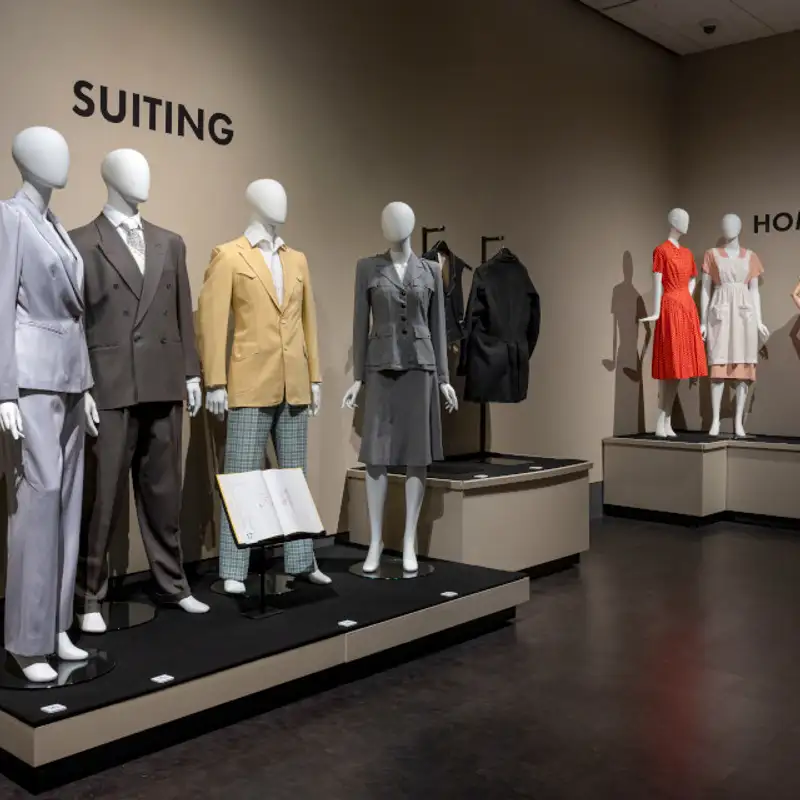
Colorado State University’s Avenir Museum of Design and Merchandising is celebrating this often-overlooked feature with its new exhibit, Thanks! It Has Pockets. This fascinating showcase dives deep into the pocket’s surprisingly controversial history along with its role as a symbol of empowerment, economic trends, and even political movements.
From its ties to the women’s suffrage movement to its evolution as a statement of autonomy, the pocket is far more than a convenient place to stash your wallet or phone – it’s a reflection of social change.
Today, I’m speaking with CSU Assistant Professor and Avenir Curator, Paula Alaszkiewicz, about the process of bringing this exhibit to life, the stories behind the pocket, and the hidden gems unearthed in the Avenir’s collection.
HOST: Well, thanks so much for being here. I love your shirt.
ALASZKIEWICZ: Thanks! It has pockets.
HOST: Ah, that is one of those things that I feel like is almost an automatic reaction. We really do love when anything has pockets. Was that the inspiration behind this exhibit?
ALASZKIEWICZ: It wasn't necessarily the inspiration, but it came to represent lots of the findings that were uncovered throughout the exhibition process and encapsulated all of them, including very complex historical themes and ideas, in a phrase that many of us, if we have not said, have certainly heard at some point. The inspiration for the exhibition was actually a single object in our collection. It was a mohair coat from the 1930s, a lovely lilac color. It has large, about eight by 10-inch, teardrop shaped patch pockets. Those pockets represented, for us, the perfect marriage between function and fashion and how those two ideas sometimes are compatible and sometimes are incompatible.
HOST: How did pockets evolve from their origins as small purses worn by both men and women in the 15th century?
ALASZKIEWICZ: The necessity to carry one's personal possessions around with them is a pretty universal human need that we see across cultures, across history. For most of history, as you mentioned, that need was satisfied with purses or pouches that were worn by both men and women. Of course, an external purse is less secure, more prone to falling off, being forgotten.
So, it's a natural evolution to want to incorporate the portability offered by a purse into something more secure. The evolution into pockets integrated into garments is part of a bigger evolution in sewing and garment construction techniques that happens in the medieval period in Europe. This is the time when professional tailoring takes off. So, we see all kinds of remarkable innovations in garment construction that become much more complex. By the 15th century, we are seeing a more intensified binary gender distinction between clothing intended for men and clothing intended for women.
HOST: So, this is where the big divide starts, huh?
ALASZKIEWICZ: Well, it starts before this, but those tailoring techniques really give rise to greater variation in cut. Of course, this is all tied up in other things that are happening in culture and society more broadly, but men's clothing in the 15th century evolves to being baggier. I like to tell my students in fashion history that men's clothing has a certain swagger to it, in that there was a lot of volume built up around the hips to increase the scale of men's bodies as they're walking. Well, all of that volume is the perfect place to incorporate pockets.
HOST: Why did pockets become integrated into men's clothing, but not so much into women's clothing? What happened there?
ALASZKIEWICZ: That's the major question. From the evidence that we have access to, we know that certain women of status, like Queen Elizabeth I, ordered gowns with pockets integrated into the garment itself.
HOST: Smart lady.
ALASZKIEWICZ: Smart lady, and a lady of means and status. For most women without such means and status, that was not a common experience. We have to think big picture for why that might be. It's not simply because the cut of clothing is different, and the construction is different. As the capitalist marketplace is expanding, Women needing to carry their possessions around with them, and carry money around with them just wasn't a common factor because participation in that capitalist arena and public marketplace was by and large the role of men. So, to need pockets to be able to go out and participate in public life really was not consistent with the dominant gender ideas of the time.
HOST: So, women didn't need them.
ALASZKIEWICZ: Exactly, didn't need or shouldn't have. One of the major themes to be aware of with pockets is of course the privacy that they offer. Pockets hidden within clothing provide a private place. At this time, women were subject to a legal concept of coverture, which essentially suggests that married women are under the cover of their husbands. So, all property, including personal possessions, was owned by the husbands rather than the women themselves. Pockets, therefore, are a way that women negotiate and can experience both privacy and property ownership at a time when those ideals are largely denied to them. From about 1650, the mid-17th century, through to the end of the 19th century, the pockets that are most commonly worn by Euro-American women are detachable tie-on pockets.
HOST: Like panniers?
ALASZKIEWICZ: Yeah, worn underneath panniers, perhaps in the 18th century, so they're not structural, but they are large, flat pouches, and they range from an average of 12 to 16 inches. So, they were quite large, and they would be worn somewhere under or within the many layers of skirts and undergarments that women were wearing at this time.
The outer skirt would have a slit in the side that would provide access to this pocket that's worn underneath the skirts. So again, taking us to the idea of privacy, of possessions being held within this much more intimate, private space between different layers of clothing, close to the body. Of course, these tie-on pockets are less secure than pockets that are incorporated into clothing, but their versatility and flexibility is also something that is really privileged and was prized by the women who used them.
HOST: At one point, pockets became quite controversial. I'm thinking of the era of the suffragettes where pockets in women's clothing were not necessarily illegal, but they were scandalous because that's where women could hide voting pamphlets and women's suffrage literature.
ALASZKIEWICZ: Pockets throughout the 19th and early 20th century become very symbolic in the women's suffrage movement and broader movement for women's rights. There was an American women's right activist in the 19th-century named Elizabeth Cady Stanton. She described pockets as a question of morals rather than a question of fashion. She suggested that without access to safe, practical, functional pockets, women were subject to unsafe situations like being more prone to being robbed or being in an accident because they're too preoccupied carrying all these things in their hands and they maybe don't see a carriage coming down the street. She appeals to a broader social good that could be achieved if women could have pockets.
Stanton shares in one article an anecdote about a young woman who's helping her blind mother cross the street. Her hands are full, she's carrying her purse in her hand in an unsecure way, and she is robbed. The man who robs her ends up going to prison. Elizabeth Cady Stanton summarizes that if only women had pockets, not only would this young woman still have her money, but this thief would still have his liberty.
Fast forward to the early 20th century, as the suffrage movement is becoming more organized. Pockets have now become a metaphor for women's right to vote.
HOST: Pockets are often viewed as functional, but they've also been used as a fashion statement, a design element.
ALASZKIEWICZ: One example would be the American sportswear designer Bonnie Cashin. We have two of her pieces in the exhibition. Pockets were very important to her design practice in creating clothing that was both stylish and functional for women who were on the go. In 1940, she asked her mother to sew a purse onto her coat because she was frustrated by the lack of pockets in her coats. So, this is a preoccupation that predates her time as a designer. One of the first big moves she makes is to patent a design for a hands-free purse coat or skirt, so a variation of what her mother made for her, where a purse with a little kiss clasp that opens is integrated into the side of a skirt. She continues in this way by making pockets that are very visible and conspicuous. One of the really interesting things about pockets is that they can either be hidden within the side seam of a garment or within the lining of a jacket, or they can be really visible and celebrated on the exterior of the garment. That's what we see someone like Bonnie Cashen doing, making the pocket really big, really visible, and calling attention to it. We also have a piece towards the end of the exhibition by the American designer Richard Blackwell, who is most known for his glamorous Hollywood designs. The piece that we have in the exhibition is an evening dress – a high neck, sleeveless, long, very elegant evening dress made from metallic, colorful floral printed silk. Down the side of the skirt on each side it has three large cargo pockets.
HOST: Interesting choice.
ALASZKIEWICZ: A very interesting choice. Would these pockets even be used by the person wearing this dress? Perhaps for a lipstick and a credit card, but the silk is so delicate that their functionality is somewhere on that hypothetical scale of function to fashion. We really see in that case the example of the pocket as a design element. It may not need to be used, but it's there to celebrate the pocket.
HOST: As we're talking about these purely decorative or fake pockets, I think that's a common frustration, especially in women's clothing. Why do these design choices persist? That idea of the fake pocket. I don't think there's anything more irritating than going to put your wallet away and realizing, oh no, this is a fake pocket. Why?
ALASZKIEWICZ: Yes, you've touched on what I think is a universal frustration for many of us who have purchased clothing that either has pockets that are so small; they're non-functional, or, worst of all, fake. What is remarkable to me, having worked on this project, is the way that many of these themes continue to resonate across history even when we're no longer in a fashion system and social system that fully denies pockets to women. There was a study conducted in 2018 that found that the iPhone X could fit in 100 percent of the front pockets on men's jeans and only 40% in the same pockets on women's jeans.
HOST: That tracks.
ALASZKIEWICZ: So, many of the themes and frustrations that were encountered historically continue to resonate today. Some of the reasons are similar to the reasons in the past and some are different. By and large, fashion is still a system that operates on a pretty strict gender binary, and the way that clothing is designed for genders in a binary system emphasizes certain parts of the body and certain ideas of functionality or decorativeness. That is a factor in why clothing is cut in different ways, and clothing for one gender might be cut with more ample room for larger pockets versus clothing for another gender.
One of the most common arguments, throughout history and today, for lack of pockets or fake pockets is that they, quote, disrupt the line of the intended silhouette. Designers have imposed a vision of what women's bodies should look like, and in this ideal sense they're really imposing the structure and shape onto the body. That to have a pocket, and heaven forbid, have that pocket full of things, would disrupt the idealized line and silhouette that they are trying to achieve or impose.
The final reason is one that's more about economy, and resonates in our increasingly fast-paced, ultra-fast fashion landscape. Pockets require more labor and more material and in a system that prioritizes profit over anything else and is looking for ways to reduce costs and possibly cut corners, and cutting pockets would be a way to achieve that.
HOST: That gets into my next question. There's that famous economic theory that ties trends related to the length of a woman's skirt to the economy. Is there a similar connection between pockets and the economy? Are we about to see a lot of fake pockets?
ALASZKIEWICZ: Sigh. We might be. Certainly in economically unstable or turbulent times, we do see throughout history economies being made, simplifying, streamlining, doing away with excess whether it's wartime rationing and the number of buttons or the width of lapels and hems being regulated and silhouettes become more streamlined to reduce an excess use of material, we do have numerous precedents for such solutions to economic hardship. We may indeed see pockets be one of those luxuries that is cut in economically difficult times.
HOST: I was thinking about the excess of the '80s and early 90s, Michael Jackson's red leather jacket that had like a zillion zipper pockets. No real reason, but a ton of them. And cargo pants or JCNO jeans with those giant pockets. I just saw a video of an influencer, who puts on a pair of vintage JNCO jeans and then proceeds to put an unholy amount of things in the pockets – a discman, a magazine, a DVD, a full bottle of body spray, just a ton of things. So, I guess we've got to hope for a resurgence in JNCO jeans?
ALASZKIEWICZ: Something that interests me very much as a fashion historian today, when I think in 50 years, in 100 years, when historians look back to the 2020s, how will they define the dominant style of the decade? There are so many styles happening simultaneously. One narrative, maybe, we'll see in the next few years in pockets is one of the design elements that is cut or further reduced in size because of economic pressures. A counter narrative to that is the resurgence of Y2K late 90s, early 2000s fashions, particularly in the demographic of our students, I see it in my classes, who are prioritizing, for many reasons, buying vintage and secondhand over new. They are sourcing cargo pants, like the ones you mentioned, from the early 2000s that have a plethora of pockets, more pockets than one would know what to do with. We have a pair in the exhibition that are from about 2000, a pair of cargo pants. They have 10 pockets on them that provide a total of 308 square inches of storage.
HOST: That sounds like about the right amount, I think.
ALASZKIEWICZ: You could go camping and not take a backpack if you just have your early 2000s cargo pants. So, we may see those two narratives.
HOST: Why do you think, because we're talking about the humble pocket, it seems like an odd thing to be talking about, but it does inspire a strong feeling of agency, autonomy, and joy. Why do we love our pockets?
ALASZKIEWICZ: That is exactly what I was trying to capture in the title, Thanks! It Has Pockets. That sense of joy and wonder and delight that many people feel and experience when surprise, surprise, that garment you like and try on and take home also has pockets. That reaction must be the other side of the coin to having experienced the opposite, the lack of pockets.
We can only experience the joy and sense of autonomy in that way of I can go out in the world and carry my possessions around with me in a secure manner, as the result of having been denied that feeling in the past. I think it is remarkable that in the hundreds of years that this exhibition covers of an ever dramatically changing world, both big picture and in terms of fashion, that the pocket continues to resonate is remarkable.
HOST: There is something so wonderful about having that freedom.
ALASZKIEWICZ: Another possible avenue of joy related to pockets that we explore in the exhibition is finding something in your pocket.
HOST: Oh, yeah!
ALASZKIEWICZ: Money, an earring. I found sunglasses in a pocket recently. So, we also can both lose things in pockets or potentially give our future self the gift of finding something in a pocket.
HOST: So, my mother passed away in June, and I kept some of her sweaters, her cardigans, that she always wore. And when I pulled one of them out and I put my hands in it, I found Kleenex, clean Kleenex. It made me laugh because my mother was always known to have a huge wad of Kleenex in her pockets, and she'd always have one at the ready. So, it gave me just this little moment. I just left them in there.
ALASZKIEWICZ: Yeah, it's so sweet. My grandfather always carried in his pocket a gold coin from the Canadian mint, like one of those solid gold coins. I think his mentality was, no matter what happens, I always have something valuable if I get into trouble. Keeping valuables close to us in pockets that, that space kind of between the outside world and the body, the space of intimacy is also where people keep sentimental valuables.
HOST: Well, thank you so much for talking with me about this. I really appreciate it. It's been so great. It's really fascinating.
ALASZKIEWICZ: Thank you for having me. It's been a pleasure to share the joy of pockets.
OUTRO: That was Avenir Curator Paula Alaszkiewicz, speaking about the museum’s current exhibit, Thanks! It Has Pockets. The exhibition is on display through March 14. I’m your host, Stacy Nick, and you’re listening to CSU’s The Audit.