Loving Yosemite to death: The long history of overcrowding in national parks
Download MP3Speaker 1: [00:00:01] Welcome to Colorado State University's podcast, The Audit, where host Stacy Nick talks with CSU faculty about topics ranging from their latest research to current events. [00:00:10][8.7]
Speaker 2: [00:00:17] Yosemite National Park welcomes more than 4 million visitors each year, but those visits come at a steep environmental cost. Trampled vegetation, along with sound, light, and air pollution disrupt the park's delicate ecosystem, drowning out birdsong, dimming the stars, and obscuring the stunning Sierra Nevada range. Meanwhile, increased development within the park has added to the problem, amplifying the damage caused by natural disasters such as floods. Winter storms, and wildfires. Colorado State University Associate Professor of History, Michael Childers, researches the environmental impact of recreation and tourism, focusing on the ski industry and US national parks. His new book, The Mountains Are Calling, Tourists and the Unmaking of Yosemite National Park, uses one of America's oldest national parks as a case study of how tourism has both shaped and harmed these iconic spaces. Today we're speaking with Childers about one of the greatest environmental threats to our national parks – us – and how the unintended consequences of loving these parks is a problem almost as old as the parks themselves.
In your book, you focused on Yosemite from the perspective of visitors rather than a traditional top-down approach. Why Yosemite and why look at it from this particular perspective? [00:01:37][79.8]
Speaker 3: [00:01:38] Yosemite's a really special place to a lot of people, and because of its popularity people know it you know four or five million people go to it every year and so it has that great connection. The other part of it is that it's a great case study that came out of some research I did a while ago when I was a senior researcher on a project doing a history of the, for the park, and I spent two summers living in the park. And through that experience, realized that the real story of Yosemite was those of us walking around the valley, going to concessionaires, hiking Half Dome, and maybe less so of the story of people out in D.C., or administrators, or the more famous John Muir's. So, what is that story, and what does that tell us about tourism, its implications, its environmental costs. [00:02:35][56.9]
Speaker 2: [00:02:36] So what did you learn? [00:02:37][0.6]
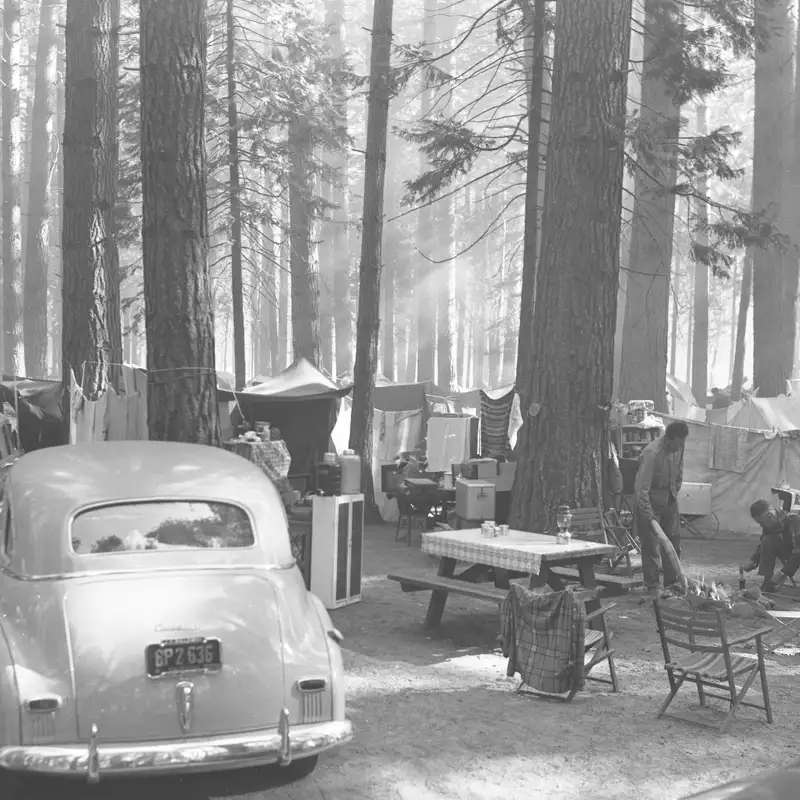
Speaker 3: [00:02:37] We have been visiting Yosemite in basically the same way since 1855 when the first group of tourists went in the park. Part of this is just the geography of the place. People enter the valley from the west, they stand on some inspiration point, whether it's the old one or the new one, and they walk up and down the valley seeing all the different waterfalls, spending the night going to Mirror Lake in the morning. These sorts of experiences have been basically the same pattern from 1855 till today, and the experiences have always been to just stand in awe and wonder of this amazing place in the outdoors. So, that experience hasn't really changed and the desire to have that experience then only grows. As we as a nation have become more affluent and recreation has become more accessible and tourism has become widely known, you have more people wanting to have that same experience and seeing this spectacular place. So, that is largely what's driving some of this overcrowding issue. And then on that front, we've been concerned about the implications and the impacts of tourism since that first group in 1855. You always have the same complaints. You know, by the 1860s, people are worried about people cutting down trees to get better views of Yosemite Falls, the impacts of have having sheep in the park to then leaping forward another century right after World War II where all of a sudden there's not enough camp spots and how are we going to find parking and then the impacts on wildlife and water quality and development and all these other kind of contemporary issues have always been a part of it. It's just magnified now because we have so many more people going to Yosemite and to all national parks. [00:04:32][114.2]
Speaker 2: [00:04:33] So we were always looking for that moment, that photo moment. Maybe not a self, well maybe a selfie, I don't know. Oh. [00:04:39][6.5]
Speaker 3: [00:04:39] Yeah, it is selfies. I mean, the photographs that you see historically are the same photographs that people are probably taking today. Same viewpoints. You know, one of my favorite photographs is from 1903 in which this guy drove the first car into the valley – which was a steam-powered Locomobile, they called it – and he has a picture of him and a couple of people in this car out on what is known as the diving board, which is this jut of granite that sits over the valley 3,000 feet below. It's the same photograph that you would see in 2020 of people standing out there on the same piece of rock. So, nothing is really truly that new. It's just that we have more people and better technologies. [00:05:29][49.9]
Speaker 2: [00:05:31] In the beginning of your book, you reference the Mariposa Battalion invasion of Yosemite Valley in 1851 when a California state militia burned villages and food supplies of the indigenous Awaneechi people to force them onto reservations. How did this moment shape Yosemite's history? Because that's very different from the perspective that we're talking about regarding tourism. [00:05:52][21.6]
Speaker 3: [00:05:54] This is important to recognize that Yosemite, as we understand it, was started in a moment of violence. So, this is 1851. California is going through some seismic changes with the influx because of the California Gold Rush. This is at the height of a regional war known as the Mariposa War, but in essence, California militiamen are invading the Sierra Nevada trying to suppress all native tribes in the region. This is just one of those many campaigns. It's also important because this is the very moment that it goes from being the Miwuk homeland into becoming Yosemite. In fact, the reason why we know about this first thing is that the doctor of the battalion of the militia, a guy named Lafayette Houghton Bunnell, wrote a book about this whole experience. Now he, of course, makes himself sound a little bit better than reality, but there he describes the first night that the militia is in the valley, trying to decide what to name this wondrous place. And then he goes through this whole exercise, and that's the moment that they decide to call it Yosemite. Trying to name it after who they believed the local tribe called themselves. It was not their name. But that moment, it actually shifts culturally so that it becomes a part of the American landscape, a romantic natural outdoors that is completely people-less and away from being a Miwuk and Paiute homeland. So, that's the origin of the idea of the park, of what we name this place. And it is born in a very moment of violence, as you pointed out. [00:07:53][118.8]
Speaker 2: [00:07:54] What were some of the other key issues facing Yosemite in its early years, and how did they also set that stage for future challenges? [00:08:01][7.0]
Speaker 3: [00:08:02] So after the Mariposa Battalion invades in 1851, news breaks out of this just absolutely wondrous valley, very remote. And so, in 1855, a entrepreneur by the name of James Hutchings decides that he needs to go see this place and possibly use it to booster tourism to California, even that early on. So, he and a couple of friends end up there that summer. He writes about it for his new magazine. And he then later moves up to the valley because he sees it as an opportunity to have a lodge and cater to tourists who have the means and the time to travel days at this point and spend weeks in this wondrous place. His move up there and the commercializing of this space immediately becomes a source of criticism. He's the one who is cutting down trees in the valley; they're putting some meadows under pasture, all these developmental sorts of issues that people are concerned that this is ruining Yosemite Valley, this sublime wonder. 1865 is also the year that the federal government cedes the valley in the Mariposa Grove to California for development for recreation, so he's also now competing with the state. So, there's a little bit of an economic leverage there. And he's forced out. He sues because he was squatting on the land, and therefore, under federal law, should have access to it. But the court case goes all the way to the Supreme Court, and in 1872 the court declares that the federal government has the right to set aside public domain for national parks. Now this is the beginning to things like Yellowstone and then later all the national parks that we now have today. But that early concern about the development of Yosemite Valley specifically for tourists then becomes a common theme within the park's history through even this morning. [00:10:24][142.0]
Speaker 2: [00:10:25] How do you mean this morning? Let's talk about that. [00:10:26][1.6]
Speaker 3: [00:10:30] After losing about a third of the park staff in the valley, the park now doesn't have enough to manage it. That's one of these points. The other one, we're looking at probably one of the busiest tourist summers in history, and the park service just decided not to have its reservation system, meaning it's not going to govern the number of people going into the park. That's largely due to pressure from local communities who see every car driving past as dollar signs. This leads then to overcrowding and other debates about what is too much in the valley. People are not going to be able to find camping spots or parking spots, you're going to have to stand in queue to walk up to see a falls, and then there'll be a demand for more development and more, we need another pizza parlor, or do we need more trails, these sorts of things. So, it's an issue that is very much on the front page and is a microcosm of this larger discussion we're having about how do we manage these national parks – particularly the big popular ones, like Yosemite, Yellowstone, Rocky, Arcadia – when we all want to be there and we all want to there at the same time and we can't. [00:11:49][78.7]
Speaker 2: [00:11:50] I think everyone has that idea of what a trip to Yosemite is going to be. It's going to be this grand moment where you get to see this beautiful view and it's just you. And that is not the reality anymore. [00:12:03][13.5]
Speaker 3: [00:12:05] It's rarely reality. I mean, you can have those rare moments, of course. But this also has its historical roots in how we understand these sublime landscapes. But really, it comes from Ansel Adams' photographs. I mean this is one of the aha moments I had along the way. So, Adams becomes famous for taking photographs of Yosemite. He lives in the valley at the time. And his photographs largely are beautiful landscapes with not a single person in the frame. So, people want to go and see and experience that. And they've been led to experience that. But they show up, and suddenly they're three deep looking at the same image that they wanted to capture with their own phone that Adams captured. One of the moments where this really came together for me was my wife and I went to Yosemite just on a long road trip, and we drove up to Inspiration Point the first night, as everyone does. And we spent the first several minutes trying to jockey our way to get a picture of ourselves, or even without ourselves, without any other people in the foreground and finally just gave up and just started taking pictures with all the crowds. And I had a realization that the story really is that we're sharing the space. It is the visitors in the foreground that we need to talk about and that we can't have this almost mythical experience of being there by yourself. Now, when that experience becomes too much, that's when we have a problem. It's fine when you're sharing it with a handful of people but when you are at an overlook or in the valley or on a trail and it's so crowded that you can't hear yourself think, that you might as well be in Times Square, then that erodes that National Park experience that we all expect. [00:14:06][120.3]
Speaker 2: [00:14:07] Do you think people are getting that, that they understand it? [00:14:09][2.5]
Speaker 3: [00:14:12] No, um, we always get really cranky when we're in crowds and we didn't expect them. It doesn't matter what the experience is, you know, if you go to a ball game and why do I have to stand in line so long to go to the bathroom or whatever the line might be. But we have this expectation – and, like I said, this goes back to the origins of the park and being these romantic landscapes where you're the only person that can contemplate and have that moment of reflection – that has been sold to us. So, when we show up and it is overcrowded, it really becomes an adverse moment. It doesn't matter what year it is, there's always someone complaining about the crowds – whether it is in the 1860s, where there's just too many people, and that year, I think about 170 people showed up for the whole year, or 1970, where you couldn't find a parking spot or a camp spot, or 2020. Actually, 2020 is a totally different experience because of the pandemic. But that expectation – we have it, but it's not reality, especially in the summer months and more so throughout the entirety of the year. [00:15:40][88.1]
Speaker 2: [00:15:41] You mentioned 2020. I think for a lot of people that is the moment that they kind of got the idea that this was a problem, a real problem, because everybody was seeking a way out, a way to experience outside that was the safe place to go. And it turned out not to be because everybody had the same idea. Talk to me about how that changed how Yosemite handled visitors. [00:16:06][25.0]
Speaker 3: [00:16:07] So, we were all locked indoors or couldn't go to work, so the outdoors across the country became overwhelmed. It didn't matter if it was here at Horsetooth Reservoir or if it was Yosemite National Park. But the park, because of public health issues, couldn't allow this level of people in. So, they shut down the park for a while and then reemerged with a reservation system. They severely limited the number of people. That year they limited it to somewhere around two million visitors, so about half of contemporary numbers. And it did a couple things for the management of the park. One, it made it a whole lot easier to manage because land management is always people management first and foremost. And it did a bunch of wondrous things for the health of Yosemite. The meadows, the grasses grew back, the birds came back, the smell in the air was cleaner because you didn't have as much exhaust. It was just a lot more pleasant. And then for those who could get in, they themselves had a much different experience. I interviewed one young woman who is a ranger in the valley, and she said that summer was great. She could stand in one of the meadows, and the grass was up to her waistline. And that constant hum of cars driving around wasn't there. Then even after the pandemic subsided, and they kept the reservation system in place, it was just a lot less stressful to be able to drive in and, oh, there's a parking space that I can find a little more readily. And you're not standing shoulder-to-shoulder at the base of Yosemite Falls. The experience of this place improved as much as the health of the environment. Now, as I said, economics has kicked in, and the gateway communities don't particularly want to see that limitation, because to them that's limiting their economic growth. How many people are going to stop off and have lunch and buy a t-shirt and ice cream as they pass through to the park. So, they have pressured the federal government to remove that, and that's what happened this year, and we'll see how that goes. But you have this push and pull, because people will always want to go and see the park. So, how do we regulate that is that open question. [00:18:46][158.5]
Speaker 2: [00:18:54] I'm wondering if visitors will decide, you know, it's going to be too crowded. I'm going to a smaller park this year. Maybe a trip to Yosemite is not a thing I do every year. Maybe it's a trip that I make once a decade. [00:19:09][14.9]
Speaker 3: [00:19:10] Yeah, and I think that has already happened over the last 70 or so years. People now are thinking about, okay, do I really want to be there on a three-day weekend because it is going to be so crowded. Maybe I should go to an adjacent national park or go to a smaller park, like some place in the Mojave, Joshua Tree or something like this. But there's still going to be several million people that go there. What possible solutions can there be in there? There are always structural ones with legislation and funding and these sorts of things. But I think, culturally, that's where a lot of us are going to have to be is that maybe we should not expect that we can just go to Yosemite whenever we want and have the experience that we want to have. That it is a once in a decade, maybe once in a lifetime experience. And this, of course, is going to affect folks who are a little bit more local than those of us who are not. Because like a lot of national parks, Yosemite is a fairly regional park. In terms of visitations, the number one place people come from is Los Angeles, then San Francisco Bay Area, then Fresno. And they do it simply because, oh, that's enough drive, and we can get up there. Maybe that's going to have to shift. And you interview enough people, or even read their diaries from the 50s, 60s, and 70s where like, we don't go back there anymore because the experience I had as a child, I can't have anymore because it's become too crowded, it's too developed, it's too whatever. So that's sort of culture has started to shift for some people, but clearly it hasn't slowed down any of the growth and visitation. [00:21:16][126.0]
Speaker 2: [00:21:17] There are a lot of moments that you talk about some of the more difficult interactions people have had at Yosemite, and how it's changed. But there are also a lot of moments of beauty. I wondered if you could share some of your favorite stories from your research. [00:21:33][15.5]
Speaker 3: [00:21:34] Yeah, I mean, for all the negatives, Yosemite is a wondrous place, and people love it. And possibly my favorite story that came out of the research was in the 1940s, and this is right after the beginning of World War II. And the park was largely empty because of wartime restrictions on travel and gasoline and just the war effort generally. A ranger was walking up to Nevada Falls and saw an elderly man sitting by himself. So, he walked up to him and asked how he was and what he was doing there. And the man tells him that his wife and son have walked up to see the falls. They’re here for one last visit before his son ships off to the Pacific. Turns out this is his youngest son, and his eldest died at the USS Arizona in Pearl Harbor. The ranger was very struck by this. He went back and wrote a memo to the superintendent who then wrote a memo to the director of the National Park Service, who used the story to point out that the real value of the parks during this time of war where everything materially had to go into the war effort – cutting down trees in Olympic or industrializing. But the real importance is that these are places of healing and solace and that we should really keep them in place despite what the world was undergoing at the time. And it really hit that tone of why we love these parks so much. Highlighting this moment of absolute global collapse with this one moment of solace for this family. [00:23:32][118.3]
Speaker 2: [00:23:34] It speaks volumes and it's a very different tone, but COVID also goes back to the idea of that's where people sought to go, it was an escape. Were there any other moments that really struck you? [00:23:51][17.5]
Speaker 3: [00:23:52] There were some that were a little funny, maybe not for the people who lived through them but... At one point the Tioga Road goes over the top of the Sierras, and it's the one road that travels across the park. It's closed during the wintertime, largely because the snows up there, just too much to maintain. At one point, the Rangers had pulled over a family that the father had – and this was somewhere in the 1950s – had broken the lock on the gate and had driven through the snow up and over, forcing his way through drifts to get to the valley. The rangers actually made him drive back and repair the gate. I'm assuming they gave him some tools in which to do this. Then when he made it back to the Valley to pick up his family, he decided to spend the week there because it was such a beautiful place. So, you had a lot of those sorts of stories. And then every time that I would talk to people, they have their own story about Yosemite. Everyone has that personal connection to the park through our own visits, and that is as important as really anything else. And I think that's sort of the power of national parks and the outdoors. [00:27:17][204.7]
Speaker 2: [00:27:18] So what is your favorite visit moment? [00:27:20][2.0]
Speaker 3: [00:27:22] I'm going to say the first time that I saw Yosemite. I was on a road trip with two friends. I was living in Las Vegas and going to grad school at the time, and I had never seen Yosemite. So, we did this multiple day trip, and we drove into the park from the East. So, from Lee Vining up and over. So, a little different entry than a lot of people. And we stopped off at Olmsted Point, which is this overlook that looks down into the valley. And that's the first time I got to see Half Dome, and I remember the smell of the air not only because of the pine trees but because you're so close to the Pacific Ocean, at least for a Colorado kid, and just how amazingly beautiful it was. And then being able to drive down and my friend was good friends with the museum curator, so that afternoon we got to go into the back room where they store all the stuff for the museum and seeing some of the first pencil drawings that were ever made of the valley. So, it became a pretty special place not just because of its beauty but also because I had this special moment. [00:28:34][71.9]
Speaker 2: [00:28:46] So you got that kind of, that unique glimpse that people all want, that we all crave? [00:28:49][3.4]
Speaker 3: [00:28:54] Yeah. [00:28:54][0.0]
Speaker 2: [00:28:55] How does that compare with your last visit? [00:28:57][2.4]
Speaker 3: [00:28:59] Ah, so my last visit, a couple years ago, and I was traveling to Mammoth. And so, I just drove up once again to Olmsted Point, and it was kind of late season, so it wasn't very crowded. There was no reservation system yet to get in. A nice view looking down in the valley with this time my wife. We didn't want to venture much further though, because we knew that driving down even to the valley, we'd get stuck in traffic and wouldn't be able to make it back in time. Worst case visit at one point is when she and I were on that same road trip and she wanted to hike and we had a dog, so I was just going to hang out with the dog. It took me an hour to find a parking spot, and then walking around the village was just a zoo, like Christmas time at a mall. So yeah, I've had the breadth of all the experiences. [00:30:07][68.2]
Speaker 2: [00:30:08] Does it change for you, like, do you now think, maybe I'm done visiting Yosemite? [00:30:15][6.2]
Speaker 3: [00:30:16] Now that the book is done and out in the world, I want to go back and see it again, not having to think critically about landscape. But I'm not doing it this summer, and it will be something that we will plan in the future. So yeah, I think I need to practice a little bit of what I preach in that I don't have to go to it all the time, and it becomes a special trip. And that has given me pause about how I think about other places, too. Regionally, Rocky Mountain and Yellowstone being closer here to Fort Collins, maybe I don't need to go there as often as well. So that it's a little bit more protected in its own right. So yeah, it does make you think about it. I most likely will not be going back to Yosemite in the next couple of years. [00:31:14][58.0]
Speaker 2: [00:31:15] One of my last questions as we're wrapping up, vacation season is here and millions of people are going to be heading to Yosemite, to Rocky, to all these parks. What do you hope travelers will think about as they plan these trips, and what suggestions would you have for them? [00:31:37][22.2]
Speaker 3: [00:31:47] Obviously, don't only think about the big, crown jewel parks. There are 400-plus national park units across the country, and they're all really special. Think about going to places like Hovenweep or historic sites like Brown v. Board of Education in Topeka. Get to know – especially as it’s the 250th anniversary of the nation – that part of the park. Then, plan ahead. I mean, you're almost forced to anymore with the reservation systems. Be okay that you are going to be there with other people. You're maybe not going to have that Ansel Adams moment. But when you do, treasure it. A little bit of patience and grace goes a long way with any sort of trip. We also need to be aware that the park personnel are overstrained. The DOGE cuts really impacted the National Park Service more than a lot of other things. They've lost a third of their staffing in Yosemite alone. So, picking up your own litter and staying within bounds and that sort of stuff is going to be really helpful for all of us. And then come away with the experience knowing that we need to do more for these parks. We need to hire more rangers and naturalists and law enforcement and archeologists and firefighters and historians, too. Don't forget about us. Not only to make our own experiences so much better, but to protect all these places. [00:33:32][104.8]
Speaker 2: [00:33:33] Well, that's good to be thinking about as we're planning our trips. Thank you so much for your time. [00:33:38][5.1]
Speaker 3: [00:33:38] Oh, thank you. [00:33:38][0.4]
Speaker 2: [00:33:40] That was CSU history professor, Michael Childers, speaking about the issue of overcrowding in our national parks. I'm your host, Stacy Nick, and you're listening to CSU's The Audit. [00:33:40][0.0]
[1927.1]