How are past wildfires altering the future of forests?
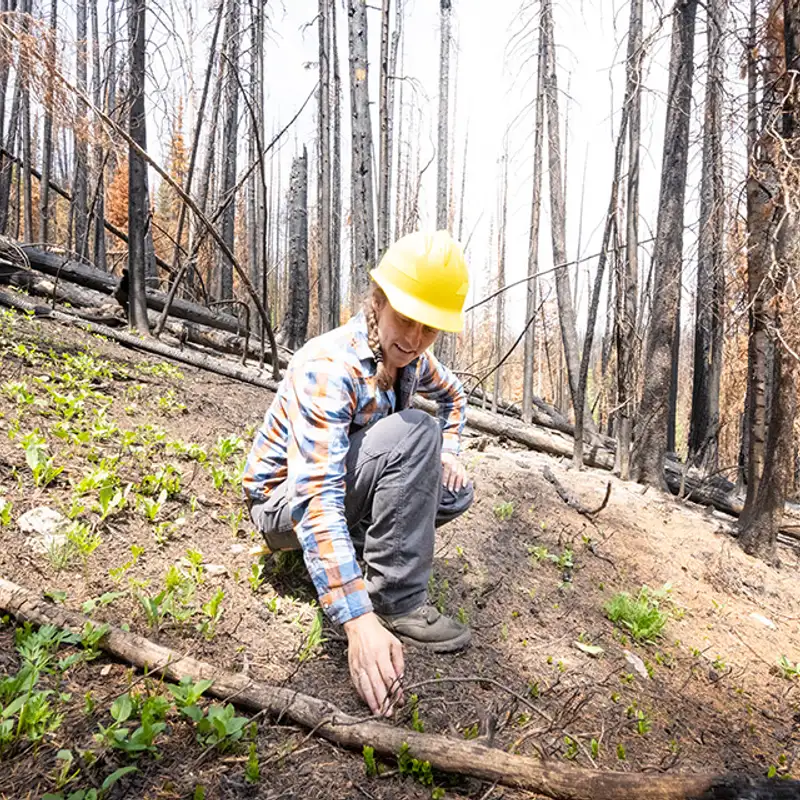
Download MP3INTRO: For years, Camille Stevens-Rumann was a wildland firefighter, working on the front lines to protect forests. Now the Colorado State University associate professor of Forest and Rangeland Stewardship fights forest fire destruction in a whole new way, researching the recovery process. And there have been some big shifts in how ecosystems return post fire.
Because while the expectation of wildfire recovery is a return to the same forests that were there before, in some places ponderosa pines are being replaced by aspens, in others forests are being replaced completely by grasslands.
How we respond to these changes is also at a bit of a crossroads. We can work to recreate the forests of the past – an expensive and potentially fruitless endeavor – or we can lean into these shifts and the forests of the future.
Stevens-Rumann recently spoke on CSU’s The Audit podcast about why forests aren’t bouncing back after fires like they used to and one unique (and slightly controversial) solution to the problem.
HOST: After some of these big fires that we’ve seen in the last few years, forests don’t seem to be bouncing back the way that they used to. Is that real, or am I just being impatient?
STEVENS-RUMANN: Yeah, I think it’s probably a little bit of both. There are definitely some places where they’re coming back really well. It just takes a long time. But there are definitely other places that are not recovering and are not turning back into the forests that we expect them to be.
HOST: What areas are you seeing in particular?
STEVENS-RUMANN: Especially our lower elevation forests are really dominant. So this is like our ponderosa pine. Think about places that surround Horsetooth Reservoir or near Boulder. Those really low elevation forests are having the hardest time recovering. But then we also see a little bit of lack of regeneration at the highest elevations also, mostly because those trees take a really long time. So we may not see regeneration for 50 years outside of something like aspen, and that could be okay.
HOST: It’s also changing the types of trees that we’re seeing come back in those areas, right?
STEVENS-RUMANN: Yeah, we’re seeing a lot of movement potentially of different species with some definitely being winners, aspen being one of them, which we all love. We see a lot of that both moving up in elevation, but also expanding within those fire footprints. Places that we didn’t see it in the overstory before, but maybe it was just dormant or in the understory is now the dominant thing that we see out on the landscape. And we see that in the Cameron Peak Fire area or the East Troublesome.
The other species that’s doing really well after fires is lodgepole. That’s kind of our mid-elevation forest that’s really fire adapted. They have seeds that fall out of closed cones right after the fire starts. Those seeds end up regenerating really quickly right after the fire. So, we tend to see these blankets of tree regeneration and they are moving up in elevation, as well. We see them expanding into more of our spruce/fir forests.
HOST: Which ones again are not doing well? Who are the, I hate to say the word “losers,” but which trees are not coming back as well?
STEVENS-RUMANN: One of the ones that we love especially here in Colorado is the ponderosa pine. And that’s, again, kind of our lower elevation forest. It’s the ones that some people think smell like cinnamon or vanilla if you give it a hug. They have really red bark, puzzle-y bark. Those are really not adapted to these high severity fires that we’re having. So, not only is the climate getting hotter, but the type of fire that we are having is not typical for those trees on the scale that we see it now.
HOST: What does this mean for the future of forests? What will they look like? What can we expect?
STEVENS-RUMANN: Optimistically, I like to say that we’re not saying goodbye to forests, but rather maybe we’ll see them on up the hill. We are seeing tree regeneration at higher elevations. I do have hope that those areas will still be forests. But I think we do have to adapt and think about how those forests are going to look differently. If we want a type of forest in a specific place, we might need to be thinking more creatively about what could be there. Maybe it’s not the ponderosa pine that was there, but maybe it’s another pine tree that’s similar, but really adapted to hotter and drier conditions.
HOST: You’ve had some success with some somewhat controversial tactics that require us to think a little bit differently about what trees we plant and also where.
STEVENS-RUMANN: I think we’re in a time of such rapid change that we really need to be thinking proactively if we do want a forest in a specific place. Some of the things that we’re experimenting with is if we plant a different variety of species. It doesn’t have to be species from a different country, I’m talking about moving, say our ponderosa pine to higher elevation or moving our lodgepole even higher. Or maybe there’s different pockets or different locations where some of our highest elevation trees might be.
But it is hard for us to think about whether or not we should be planting in these different ways than where the tree was right before. That’s really hard. I do think in some places, especially at our lower elevation forest, we probably need to get more creative. One of the things that we do know from a lot of the forest service plantings is that even if you move a tree up, say like 300 feet from where its seed source was — which is not very high up the hill; that’s something you could do in a 15 minute walk or less — you are getting greater survival of those trees. So, when you think about that seedling that you as a volunteer or the forest service or anybody is putting in the ground, it’s a lot of resources and so you really want that to be successful. That’s really my main goal in thinking about experimenting is how do we increase the success of those very limited resources of planting trees.
HOST: And this is considered a little bit of a radical concept. Why?
STEVENS-RUMANN: Well, you know, we have seen a lot of bad things come from moving species around. We have lots of examples of invasive species. So there’s always warranted concern about whether or not we should be planting something where it wasn’t before. The caveat to that, I think, especially when we’re talking about trees, is they’re slower growing. They don’t tend to be quite as invasive like cheatgrass or thistle or mullen that we’ve had lots of problems with here in the West.
But it’s always a risk. You don’t know what’s going to happen as you move trees around. I think that there’s something to be said that where these trees are today is not where they’ve been 500 or even 1,000 years ago because we have had climatic shifts in the past, which means that those trees have had to move in the past to keep up with that change. So in some cases, maybe we’re moving them to where they were 700 years ago, but we don’t see them today.
HOST: So it’s more relocation.
STEVENS-RUMANN: Yeah.
HOST: And there’s never anything wrong with having more aspen.
STEVENS-RUMANN: Yeah, everybody loves aspen, it’s always a winner. Aspen is really hard to plant though, I will say. When we see it out on the landscape, it’s growing from this big root structure, typically, and we haven’t quite perfected planting it from a pot into the woods. So, that’s a little bit more difficult than a lot of our conifer trees.
HOST: What are some of the areas that you’re seeing the most difficulty in regeneration?
STEVENS-RUMANN: In Colorado’s memory, one of the big places that people often think about is the Hayman Fire, which burned in 2002, kind of outside of Colorado Springs. And that fire has an 18 square mile patch where not a single tree lived after that fire, which is really drastic to see on the landscape. You can see it from Cheesman Reservoir Fire.
There have been a lot of really great planting efforts in there that have been successful, but it’s hard to plant that huge of an area. So, there’s a lot of it that’s not regenerating and not naturally regenerating at all. So those are the kind of places, those like lower elevation forests, closer to here and more recent fires, something like the Cal-Wood Fire, you know, that burned in Boulder County through some of their Boulder County open space. Those areas I probably wouldn’t expect to come back without active replanting. Some parts of something like the Cameron Peak or East Troublesome, but most of those burned at higher elevation, and so we’re seeing a lot of different dynamics there than that kind of lower elevation forest example. But the Pine Gulch Fire over by Grand Junction, that burned both through pinion juniper woodlands and ponderosa pine forest, and those areas are really not regenerating very well so far either.
There’s a lot potential to plant, maybe in our ponderosa pine forests, we should be thinking about pinion and juniper, if like that can just move up the hill a little bit. Other possibilities might be something that’s a little more far-fetched, like some of the cool pine trees that we find in central New Mexico and central Arizona and farther south, like Chihuahua pine and Apache pine. Because if you look at them side by side those actually look really similar to ponderosa pine. They grow the same, but they’re a lot more drought-adapted because they’re found in far southern U.S. mountains. Those are some examples of things that we could have in certain places.
But I also think that we really need to think critically about do we really need and want a forest in a specific place or are we okay in some places accepting that it could be a non-forested ecosystem and help preserve and conserve it in that way. I think the worst outcome would be an invasive species-filled area. But if it’s a beautiful grassland ecosystem or something like that, maybe that’s okay too.
HOST: Now, before you got into the research side of wildfires, you were actually on the front line, working as a wildland firefighter. How does that experience inform the work that you’re doing now?
STEVENS-RUMANN: Yeah, I think it’s instrumental and absolutely drives a lot of the work that I do. It was a really fun and amazing job to have, and it gave me a really great insight into what is practical and applied science because there are lots of questions that I might think are interesting, but then I can put on my manager lens and realize that I’m not sure how I would implement that or I don’t know what the application would be of that. That makes a big difference in how I connect with managers and talk about my science. It also helps form the questions that I have as I want my work to be applicable to those people that are doing a lot of great work out in our ecosystems.
HOST: When you’re out there in the field, do you think about those moments from your firefighter days?
STEVENS-RUMANN: Absolutely, I mean I got into this field because I love being outside and whether it was fighting fire or out studying these post-fire landscapes, I think about that time and what it means to be on these landscapes in this time of rapid change. When you’re on the fire, you’re in places seeing this drastic, unavoidable, huge amounts of change all at once. It’s really beautiful now that I get to go back to a lot of those places and see what it looks like over time and how much it is coming back. Because a lot of times I find a lot of joy and surprise in what’s coming back. I get so excited when I see a little seedling or when I a see a new wildflower I haven’t seen before out in that landscape.
HOST: You mentioned that you love being outside. Coloradans have a very deep connection to their wildlands, to their forests, and what they look like. What are some of the hard truths that we may need to accept about the next generation of forests and what Colorado will look like?
STEVENS-RUMANN: One hard truth that we have a hard time accepting is that fire is natural. It’s not only natural, but an integral part of our ecosystems. By us removing it for the last 120 to 140 years, we’ve really changed what our landscapes look like. So, that deep, dense, dark forest that maybe you feel really connected to probably didn’t look like that 140 years ago.
I think that as we’re at this kind of critical juncture that we’re deciding right now whether or not these fires are going to control us — they’re going to be these big out-of-control fires — or if we’re actually going to be more in control of those fires and do things like prescribed fire and actually change that needle on the likelihood and severity and intensity of those large fires. Because we’re not going into a time of less fire globally. We’re definitely heading towards hotter and drier and more fire years ahead of us, which is scary, especially as we think about those places that we really love.
I think that as we see those transformations happen, because they will happen, even if it’s not in your specific favorite place, a thing to remember is that our ecosystems are incredibly resilient when we give them a chance to be, and maybe with a little bit of our help. But finding those little nuggets of things where you still find joy in that landscape is always a good thing because it’s sad to see something really change drastically from what you remember.
We often like to blame just climate change, but I think with our fire issues across the Western US, it’s not just climate change, but it’s our change in fire management. We know that fire suppression was really the exception to the rule of how our ecosystems have been managed for the last thousands of years by Indigenous communities who use fire really actively to change the forests and create landscapes that were adapted to them. So, that’s really what our ecosystems are used to and adapted to, which makes it difficult to go from that to 140 years of not using fire at all.
HOST: The Smokey Bear effect.
STEVENS-RUMANN: Exactly. Yeah, I love Smokey Bear but he has not done a lot of good for a lot of our ecosystems.
HOST: Poor Smokey.
STEVENS-RUMANN: Yeah.
OUTRO: That was CSU Associate Professor Camille Stevens-Rumann speaking about the future of forest restoration post wildfire. I’m your host, Stacy Nick, and you’re listening to CSU’s The Audit Podcast.