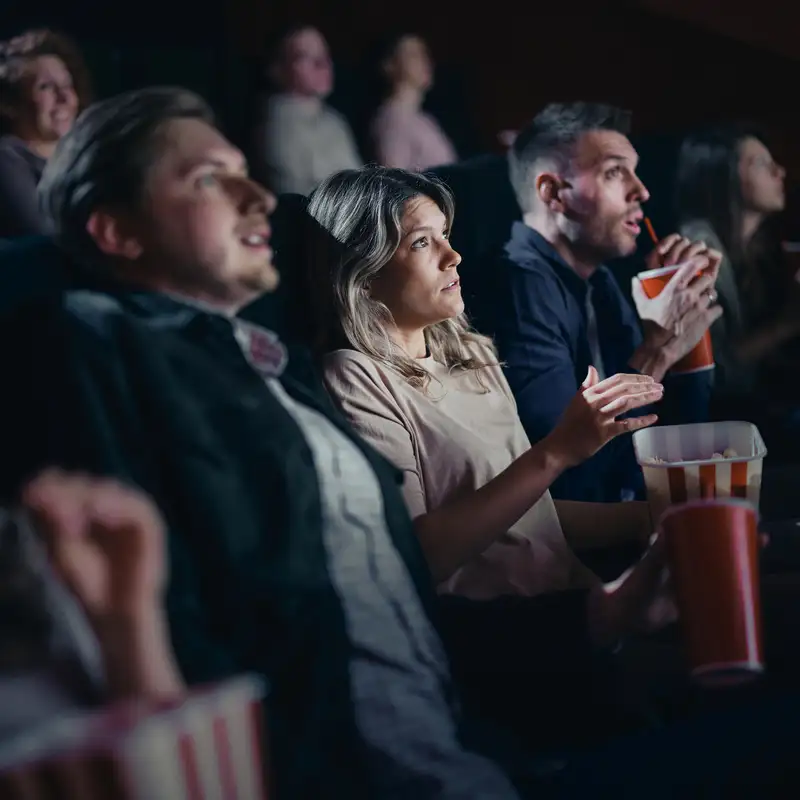
Can watching horror movies make us more empathetic?
Download MP3INTRO: Since pioneers such as Mary Shelley, Edgar Allen Poe, Alfred Hitchcock and George Romero introduced the horror genre to the masses, audiences have loved a good scare – at least when it came from the pages of a book or a seat in a movie theatre. Today, it continues to draw in the masses, putting the public on a first-name basis with the likes of Jason, Michael, Freddy and Ghostface. But what is it about the manufactured macabre that draws people in? Why do we love to be scared? And what does embracing the grotesque and terrifying say about us as a society?
Colorado State University Film and Media Studies Professor Scott Diffrient has spent a career analyzing these questions and many more. CSU recent Ph.D. film studies graduate Riana Slyter looked at the genre from a different perspective, focusing on the people responsible for making the things that go bump in the night. We spoke with both of them to learn more about the genre – as an art form, as social commentary, and as plain old fun.
HOST: I want to start out by asking both of you to tell me a bit about your work, specifically in the horror space and what drew you to it in the first place. Scott, let’s start with you.
SCOTT DIFFRIENT: I’m 53 years old, so I came of age in the 1980s. Why does this matter? Well, my work in the area grows out of my passion for the genre. I started watching horror films when I was probably way too young in the 1980s; that was the first video generation. So, we were watching everything on VHS tapes. There were lots of stores around where we could access things that we couldn’t otherwise see in movie theaters. Although I did watch horror films in movie theaters, even as a young person, I remember still today watching Poltergeist when I was about, I guess, 9 years old, maybe. And it just had a profoundly terrifying effect on me. I still remember that film. Every weekend, my best friends and I would get together and watch Fright Night or Popcorn or all the Friday the 13th films on VHS.
It just grows out of a profound love for what the genre does. It’s a very unsettling genre. It’s a very paradoxical, contradictory genre, and I think that’s part of the appeal. The reason I mentioned the VHS tapes is, I think obviously the outrageousness of the genre. The horror genre is known for its excessiveness. It’s about people put into extreme situations. I remember going into the video store and seeing Jamie Lee Curtis and her prom dress with a bloody ax in one hand and a bouquet of flowers in her other hand. I was just trying to reconcile those things. I couldn’t make sense of it. So that was kind of the initial draw. I think that’s probably true for a lot of adolescents.
RIANA SLYTER: Yeah, very similar story. And I think that a lot of people who enjoy horror would actually have very similar stories to us, too. Throughout my time in research and connecting with people who love horror and the genre, they’re very thoughtful audiences who really care and have a deep passion for what they’re doing. Scott and I just do it at an analytical level. We’re basically horror nerds who just get to research it for our jobs. That’s been really a blessing. Similar to Scott, I would bike to the local Blockbuster in the ’90s and early 2000s, I would be biking with my dad, and we would pull all these different fun films. I remember there’s something very beautiful about horror because it’s what I call a snapshot memory because it’s so intense and there’s a lot of adrenaline that comes with it. You tend to remember those films well. It’s similar to, like, I taught public speaking. It’s a scary class. It was one of the most horrifying classes because you’re doing something that is uncomfortable in front of a lot of people. So, it’s scary, but it’s memorable. And so, for me those snapshot experiences happen within horror films with my best friends, growing up with my family, but also going to attractions as well, going to the scary fear fests next door to the theme park. Or going to Disneyland. Those are snapshot memories with a lot of adrenaline and fun, and they help you remember certain moments. So, horror becomes this place of memory, both nostalgic and happy, but also kind of tormented and uncomfortable at the same time. I think that’s the cool paradox within horror is it’s up against these two juxtapositions of being, yes, frightful and scary, but also joyous and fun.
I think that paradox is kind of what Scott was alluding to, particularly when we think about the images on screen. We see Jamie Lee Curtis in a beautiful prom dress but with a bloody ax, right? There’s something about that juxtaposition that’s always prevalent and always there in horror that helps us unravel the categories that we hold onto in our society so strategically. They push both of those images to the surface in a way that makes us reconcile as audiences, or not reconcile with it, and it helps us understand ourselves and each other a little bit more.
There’s a lot of analysis out there about the “why” when we talk about people engaging with horror. But Riana, your research looked at the “how,” how people are engaging with this genre, and it’s definitely gone beyond the 2D screen.
SLYTER: One of the cool things about my work is I traced it back historically to, “How have we engaged with these frightful spectacles in the past?” Really, there’s not a whole lot of difference in terms of our interest in the macabre and the darkness of our society, whether it’s around a campfire sharing horror-filled ghost stories to attending a film that produces these spectral images in front of us. There is this desire for all things macabre and dark, and so I think those practices are very much the same. The difference is that technology makes them a little bit more immediate and a little more intense. Scott has written about how horror, particularly, is a very sensorial genre, maybe more so than many others, if not the most sensorially focused genre. We care about how it engages our senses. When you go into a haunted attraction, you can almost smell the decayed flesh; it’s very visceral. It brings us right back into our bodies. Leaving the cognitive logic sometimes and just feeling it and making sense of it through the physical means of our body. There’s something very beautiful about it, and I’m very interested in the how, and how it has increased over time. Now we have shifting floorboards, we have spiders that come down from the ceiling, we have VR effects, we have all these things that take us deeper into the narrative, deeper into story, where that separation between, oh, that’s the image on screen, becomes a little bit more immediate and a little bit closer. That is what increases anxiety, stress and fear. It’s about how we utilize these technologies and both remedial older technologies and new technologies all in play. Even with haunted attractions, they’re using Pepper’s Ghost, a technique that was invented in the 1800s. That’s an old-style gimmick that they’re utilizing in different ways now that are still really effective, so it’s repurposing the past while also engaging in more futuristic technological components of the future to create a more effective and affective scare.
HOST: You mentioned Pepper’s Ghost. For people that don’t know what that is, let’s give them a little explainer.
SLYTER: Pepper’s Ghost is an illusion. It’s the most iconic that people really remember utilized within Disneyland. The Haunted Mansion utilizes this ballroom of floating ghosts, and it just looks like they’re really there. Well, Pepper’s Ghost is a 45-degree mirror image that reflects the actual physical components of the ghosts somewhere else. So, it gives this ghostly effect. It’s something that was utilized early on in historical plays.
DIFFRIENT: Riana, you were also alluding to the ways in which filmmakers themselves, people like William Castle, have brought in haunted attraction elements into a theatrical setting. In the late 1950s and early ’60s, you’d have films like the original House on Haunted Hill and others that had these gimmicks that had skeletons dropping from the ceiling, or they had the shame corner where audiences who were too scared to watch the final scene of the film had to go and take a time out. They brought all of these haunted attraction-like elements into the theatrical setting.
HOST: During recent screenings of The Long Walk, they had people watching that movie while on treadmills, and they had to walk the whole time they were watching it. So, is that kind of maybe coming back?
DIFFRIENT: I do think that with The Long Walk and a few other high-profile releases, we’re seeing that ballyhoo style of, let’s bring people back into the theatrical experience, because so many people do watch films on their laptops or on their cell phones. They want to create that communal spirit, which again, haunted attractions are distinguished among other things by the way that they are communal public events. They happen in the public sphere. I think we’re going to see more of that happen in coming years with these high-profile horror film releases or just other genres of productions that appeal to people in ways that harken back to the 1950s and ’60s.
SLYTER: There’s a lot of conversation, particularly within the haunt community, about this ever-increasing threshold of people who experience fear. You often hear people who go to a horror movie say, “That wasn’t scary.” They want a more sensorial, immersive experience. So, that ever-increasing threshold of fear is met with a lot more technology, a lot more immersive experiences that are catered to those who are interested in a more intense experience. You will also see moving of your seats as you’re watching the film so that it becomes more like an attraction, more like a ride. And that’s absolutely true. But you can also think of all the para-techs next to the film itself. Things like the film’s social media become almost alive in some senses. There are elements of creating a more immersive experience with pop-ups and things like that. Recently, things that are Halloween or even just fall adjacent like Gilmore Girls, you’re seeing all these pop-ups even right now celebrating the 25th year. You’re getting all these experiences. I went to Walgreens and there’s all this memorabilia that’s there. They’re trying to engage the audience in various different ways. Horror obviously is a great fit for that because it’s almost meant to be felt. Like you need to physically, tangibly be a part of it, and even when it’s on a screen, it’s still physically felt. You still feel like it’s real. That real and unreal component is very, very liminal. So, I think that there is a need for that.
HOST: Riana, you visited more than 30 haunts around the world as part of your research, and you noticed something that flipped the script a bit. People usually are analyzing why people like to be scared, but you looked at the people who wanted to scare others.
SLYTER: A lot of people are very much interested in the “why,” why do we engage with fear? Why do we engage with horror? Which is a worthwhile exploration, but it has been thought about and written about for a long time now. For me, the interesting question becomes, Why do we produce fear? What about that culture is so enticing? I interviewed scare actors at haunted attractions across the country. I also worked in haunted attractions in the past and had seen the kind of love and passion behind these projects. What people don’t normally understand is that this is an art form. Very much like being a villain in a play or doing a musical where you’re Cruella de Vil or something like that, you are playing, you’re in this realm of make believe and you are the orchestrator of it all. You are the main character. How enticing is that to be the bad guy, right? Especially, in contrast, when you are in society and you don’t feel like you have a lot of power, or you don’t feel like you can enact a lot of difference. You can be in the small space that you have within your haunted attraction. You have these people coming into your haunt. They don’t know the space. It’s completely dark. They’re moving around with just their hands trying to feel through the area, but you can see them because your eyes have adjusted to the darkness for a very long time. You are the master and arbiter of all this horror, and you’re waiting for the right time to jump out and scare them. That immediate effect to make people see you, to make people feel you, to make people sense you, and to get a reaction from that is very powerful. It’s enticing and fun. I think people don’t realize that. It’s like playing a prank. Why do you sit on a whoopee cushion and get a reaction? Like there’s something about that that is powerful. As I did a lot of research and went to these haunted attractions, I found that the folks who were working behind the scenes were often very marginalized in their own communities. So, we have haunted attractions on a large scale, the multimillion dollar complexes and the theme parks that are making millions. And we have the local mom and pop hayrides that are also really crucial to their local communities and rural areas. I found folks that I talked to, especially in very strong LDS communities, would be very connected to the haunts and the people who work in the haunts because they were all the kind of oddities of society or the people who were weird or seen as like outcasts. They were marginalized. They found a home in haunted attractions where they felt that there was a camaraderie with differences. There’s a camaraderie with not fitting the status quo. It’s actually embraced and celebrated. They want you to be different. They want to be weird. They want you to embrace the marginal because that’s exactly what would scare all the normal people out in society. They want difference. And so, it became this space of community, this space of familiarity and power. That was very different to what they felt day-to-day in society. A lot of these folks worked normal jobs. They volunteered at nursing homes. That was their day job where they would volunteer and then they come home really at night in the haunts and become this other person, become this dark entity, almost to kind of exacerbate that part of themselves so that they can do beautiful things in other parts of their lives.
DIFFRIENT: Horror is a negative genre in a lot of ways. It deals with unsavory topics; it broaches subjects that we don’t often think about or talk about, much less in polite company. But it gives opportunities for people who are outliers, who feel like they are outside the system. It gives them a chance to tell their story.
HOST: Scott, in your book Body Genre, you look at the visceral elements of horror movies and how horror has a deeper meaning and purpose than maybe most people realize.
DIFFRIENT: One of the first academic books devoted to horror that I read as a film student was Carol Clover’s Men, Women, and Chainsaws. I love that title. It was originally published in 1992. Clover’s work, in addition to that of Linda Williams, who was another major scholar in the area, broached the idea that horror really went beyond all other genres and its foregrounding of the body as a potentially violated or diseased or mutated or just transformed side of meaning. Of course, it’s made meaningful in part because of our own corporeal relationship to those bodies. We have this kind of interface, this corporeal interface, our bodies to their bodies. I’m sure many listeners can recall moments when they were exposed to something on screen that caused them to react in a very visceral way. Maybe by screaming or just by shutting their eyes or turning away from the screen, or possibly even worse, you know, there are many famous instances of films like “The Exorcist.” and Julie de Corneau’s “Raw,” and the Dutch production, “The Human Centipede,” that are truly stomach-churning films that have elicited very visceral reactions. People flinch, they jump, they let out a yelp. My interest in horror goes beyond sight and sound to consider the so-called base senses. These days I’m primarily interested in our sense-making abilities with regard to taste, touch and smell. I’ve got a follow-up book coming out next year on this topic that explores, What is the mouthfeel of horror? I know that sounds weird, but there’s a kind of graininess or a pulpiness or slickness to horror films, how they figuratively sit on our tongue and sometimes leave a bad aftertaste. So, I’m kind of exploring those areas.
HOST: I was thinking when you mentioned The Exorcist, I have a vivid memory of an awful smell the first time I watched it. I felt like I could smell it.
DIFFRIENT: Sometimes it’s just witnessing people on screen, holding their nose as flies are swarming. I remember watching Amityville Horror, and that was the case, the black stuff coming out of the toilet and imagining what that smell must’ve been like. Of course, the actual sets of horror films are notorious because they have practical effects and prosthetics; they are smelly places.
HOST: Yeah, I’m sure there’s some of that that’s probably not acting but reacting.
The horror genre in general is a very popular one, but it’s also one that doesn’t get a lot of respect. Very few horror movies have received Oscars. Acting in a haunted attraction probably doesn’t carry a lot of weight as a professional role. Why do we feel the need to delegitimize horror?
DIFFRIENT: The fact that horror films historically have not been accorded a great deal of respect from within the academy with a lowercase a, and then the Academy with the uppercase A, by which I mean the Academy of Motion Picture Arts and Sciences, is a very good thing, I think. Frankly, I’m glad that horror films don’t pick up a lot of honors from that particular institutional body and that it took a long time before scholars, especially scholars in my area, began to take horror films seriously. However, I do think we’re at a stage now where, especially with the so-called elevated horror film, the kind of films made by Ari Aster and Jordan Peele that get a lot of people who aren’t otherwise horror fans to watch these films, films like Midsommar and Hereditary and Get Out. I think that’s bringing in new audiences, and it’s moving the genre forward in a very productive and interesting way. Personally, I tend to prefer the grimier, trashier sort of exploitation fare that still doesn’t get a lot of respect today. Those are the ones that most nakedly reveal the contradictions of horror. For me, the contradictions of horror really pivot on this distinction between the progressive aspects of the genre and the regressive. It can be incredibly politically reactionary and even conservative with regard to sexuality and gender and race, but it can also be very progressive and move beyond traditional notions of what those categories are. I find that the ones that are still delegitimized and not recognized are the ones that are most productive. Maybe it’s not the best example, but the one that immediately leaps to mind is the Texas Chainsaw Massacre, which for a long, long time was notorious. It was one of the “video nasties” in Britain. It had this aura around it, I think in part because of the title. Over time, it came to be perceived as a proto slasher, as a very provocative and even somewhat progressive illustration of the so-called final girl’s ability to survive by the narrative’s end. How does she survive? She survives by overcoming her fear, which is profound, but also in a way, like so many other so-called final girls that came after, by getting a read on the killer. That is getting a bead on the killer’s motives, tactics and process. That itself is a problem-solving endeavor that is interesting and really profound for us to think about today.
SLYTER: I think that there’s a murkiness to the actual statement of horror and what classifies as horror because the common sentiment is, horror is whatever I am scared of. Well, that’s very subjective. If you go into a horror movie and you leave and you’re not scared, is it a horror film? I mean, Harry Potter is a horror movie, but it’s a children’s horror film. Right? It’s classically on a lot of Halloween playlists, but people don’t assume it to be horror. What horror is incredibly murky and hard to pinpoint, and that’s the power of it, is that it can be murky. It can sift into the everyday. Often, and Scott probably gets this a lot too, when we say we do horror, people assume the type of horror film that I analyze. So, a lot of people come up to me and ask, Do you love Ted Bundy? Do you love that true crime? That is horror, I mean, technically. It’s real horror where I’m more looking into fantasy monsters and the fantastical realm. It definitely bleeds into reality in a lot of ways, but it’s a step almost removed. So, I think for us, why horror is so delegitimized is because we don’t have a good pinpoint of what it is. Or even more so people think they know what it is. They immediately have these assumptions made when I say, “Oh, I look at horror films,” they’re like, “Oh you do the video nasties” or, “Oh you look at Jordan Peele.” They assume that they know what I do before even asking and, in that assumption, it becomes kind of a delegitimization process. I think people are very much run by fear and instead of facing that fear and engaging in horror and the genre, they push it away. They’re like, “Oh, that’s a box I’m not going to open. That’s horror. That’s over there.” They don’t even ask or question or take a second to really think about it.
HOST: We talked a little bit about this earlier, but it’s been said that horror can be used as a tool to help us better understand ourselves. Even though I love horror, I’m going to push back from the perspective of maybe someone who doesn’t love horror and ask, “How does experiencing something terrifying and possibly grotesque do that?” I’m thinking about the Terrifier movies, which follow the character Art the Clown through a series of increasingly gruesome murders and torture. What can those films teach us – other than maybe that we have a very strong stomach?
DIFFRIENT: There are certain primal fears that are experienced by all humans and that are innate to the species and probably innate to other species as well, those deep-seated fears. But how often do we really grapple with that in our everyday lives, though? Certainly, we all experience traumatic setbacks. We have personal losses and familial tragedies. Those are bound to occur. We’re all going to die. But I think in terms of safely, vicariously tapping into the thrill of experiencing death and the threat of extinction, which is maybe the base of all primal fears, is central to how horror distinguishes itself from other genres. We do fear bodily harm. We fear the loss of our autonomy and agency. You asked about what does a film like Terrifier teach us? Frankly, I don’t believe that art of any kind, be it a painting, a musical composition, a video game or a motion picture, must teach us anything. But I do believe that exposure to those kinds of creations prompts a kind of sensitivity to the world. I think it prompts a sensitivity to people of the world, and I know that might sound contrary to what was on the minds of the makers of Terrifier, but I think it can actually form a kind of empathic connection or empathetic relationship to characters. It strengthens our capacity to care about others. This has been proven true scientifically. Our brains have a system of cells called mirror neurons that fire. They activate not only when we perform certain actions, but when we see others performing those actions. So, there is a kind of scientific basis for empathy and yes, Art the Clown does terrible things, but it’s the victims that I care about. I care what they’re undergoing and, yes, there is a vicarious experience, but there’s also an empathetic relationship being built.
HOST: I just watched Terrifier 3 this weekend, and it really breaks kind of one of the last boundaries, in my mind anyway. There is a moment very early on where a child is killed, and you don’t see that process, but you see the aftermath. I don’t think I’ve ever seen that before in a horror film. I even remember being a kid and thinking that there was a law that horror movies couldn’t show kids being harmed. So, watching it was really surprising to me that they had, I think that’s the first time I really saw that boundary being broken that way.
DIFFRIENT: It’s interesting. This has seemingly no connection, but I was watching the documentary about John Candy, I Like Me. John Candy passed away years ago, and he was a cast member of SCTV and in the documentary they show a sketch of him as a gunslinger in the Old West gunning down a small child in the back, which had never been depicted in television before. The reason I introduced that is because comedy and horror share something in common, that juxtaposition of the banal and extraordinary. There is this thing when we don’t expect something to happen that is part of the allure. However horrible it is, on the surface, there’s also something pleasurable about seeing something that had not been done before, that was unthinkable previously.
SLYTER: Yeah, there’s something dark about that. And it’s also important in knowing our boundaries and our borders. So, potentially seeing a child die on screen, why is that something that we don’t see very often? It happens in the news all the time. What about that boundary is something that is structured by our society? What does it say about you when you’re uncomfortable seeing that? What does that say about our society caring and preserving and protecting youth? I think that’s all really interesting. And looking at other places around the world and cinema around the world and how does that look there. What can we learn from the things that are horrifying, macabre and grotesque? Horror is always an invitation. It gives you the option to either lean in and face what you’re fearful of or go away. Both processes, you gain something. If you’re disgusted by what Art the Clown is doing, if you feel like you can’t watch, what does that say about your own values? What does that say about what you can understand about the world? Or what about if you take it a step further, can you gain something from that rejection or intrigue? Because horror does both. Horror can be very attractive and alluring at the same time as being repulsive. So, thinking about what you’re interested in, what you are not interested in and, more importantly, why, is a great invitation to follow up on and to think about maybe for yourself or even for society. I always tell my students that horror is meant to be empathetic. If you get to a point in your life where you’re being apathetic, when you’re not feeling anything, maybe it’s a good time to watch a horror film to get your senses right. How many times do we see gun shootings on TV, and it becomes just another school shooting, and we’re just like, yep, that’s just a day in the life of the United States? When you stop feeling it, that is a problem. So, what can you get to re-simulate or re-feel those things that you have suppressed or pushed away? How can you bring that to the surface and make sense of it in a productive way? Watch a horror movie. Go to a haunted attraction. Feel those things that society tells you that you can’t on a day-to-day basis. That in itself is valuable.
HOST: Since it is the prime season for horror movies and things that go bump in the night, I wanted to ask you both, just like the killer in the Scream franchise, what’s your favorite scary movie?
DIFFRIENT: I’m drawn to two very different strains of the genre, which seem kind of contradictory to one another. On the one hand, I adore horror films or horror comedies that are really upfront about their artifice. I like those films that, because they’re cheaply shot or poorly produced, they’re so bad, they’re good. I really love films like Birdemic and Basket Case and Manos, The Hands of Fate. Or films that are intentionally self-reflective and meta about their artifice, like Cabin in the Woods or Wes Craven’s New Nightmare – which I prefer to Scream. There’s also a film called Rubber which is about a psychopathic stalker who is a car tire. But I also love, love, love found-footage horror films. I know a lot of people are past that point of watching found footage. But they’re tremendously interesting to me. I love R-E-C from Spain. I love the original Blair Witch Project, all the Creep movies, the Trollhunter films. I think the reason I’m drawn to found footage is because basically our viewpoints are limited to not what the characters see, but what they record on their video cameras or their cell phones. There’s a lot of implied horror, like, oh, there’s a strange sound happening in this other room. Or I just caught a flicker of something happening in the background there. There’s all the naturalistic acting and handheld stuff. R-E-C probably is my favorite. I showed it in one of my horror film classes, and from beginning to end, all the students were just screaming. It just let loose my class in a way that I’d never seen before.
SLYTER: This is such a hard question because it changes all the time. I love horror because there’s so many flavors to horror. Like, am I feeling a psychological thriller? This time of year, as it starts to get cooler and we get into the holidays, I just really love The Shining. It’s my favorite Christmas movie. It’s exactly how I feel when I’m with my family. I’m stuck in a house, I can’t leave, and I want to kill them all. Like, thank you. This is exactly the kind of catharsis I need. I feel connected here. I always love that film. I think it’s eerie. I love films that you can go back to, and they have so many different layers every time you watch it, whether it’s the cinematic meanings or whether it is the dialog.
I also love horror films that I call all-vibes, no-plot. I know that’s not really a great classification, but horror films that are just eerie and like that you get into the vibe, there’s not really, when you leave, you barely can explain a logical plot of beginning, ending and middle. It’s just all really unsettling, that’s when I’m like, ooh, that was a good horror movie for me because it makes me circle back to what about the film made me feel that way? Was it the eerie music behind the background? Was it because there’s no resolution? There’s no killer that dies even though he’ll come back in the next film. That eeriness tends to bleed in too; after watching the film, you still feel it. I felt that way with films like Under the Skin with Scarlett Johansson. On the flip side of that, I like films that really have a strong plot, like a lot of Jordan Peele’s films. When you watch his films, there’s a beginning, middle and end, there’s story. But you’re like, I don’t feel like I understood it all. Then you rewatch it and rewatch it, and you see that this was the metaphor for this, or there’s a lot more than the surface. I felt that way with Sinners. It’s like, yes, it is a beautiful, fun production. But there’s some other pieces that you can kind of chew on later. Whether it’s a feeling to chew on or it’s a logical puzzle to chew on or pieces to kind of pull apart. I love films like that.
HOST: I think you’ve left a lot for our listeners to chew on with this conversation. Thank you both so much for taking the time to talk with me.
DIFFRIENT: Thank you.
SLYTER: Thanks Stacy, I appreciate your time.
OUTRO: That was CSU horror experts Scott Diffrient and Riana Slyter talking about why and how people connect with horror movies and haunted attractions. I’m your host, Stacy Nick, and you’re listening to CSU’s The Audit.