A roll of the dice: How Native Americans shaped gambling and probability long before the Old World
Download MP3INTRO: Did you know the earliest known dice in human history were made and used by Native American hunter-gatherers on the western Great Plains more than 12,000 years ago? Long before the dice of Bronze Age societies in the Old World – more than 6,000 years before.
Colorado State University Ph.D. student Robert Madden’s groundbreaking research reveals that dice and games of chance have been a central part of Native American culture for millennia. But this discovery isn’t all fun and games. Dice were used as social and bartering tools during gatherings of Native American groups, offering fascinating insights into how these early societies navigated trade and relationships.
Even more intriguing, these ancient dice provide evidence of humanity’s first concepts of probability – thousands of years earlier than previously thought.
In this episode, I sit down with Madden to explore how these dice were used, what they reveal about early probability theory, and how the legacy of these games continues to thrive in Native American culture today.
HOST: Let's just start with a little bit about your background and what led you to study Native American games, particularly dice games.
ROBERT MADDEN: I had previously been interested in Native American gaming, particularly in the context of the Mesoamerican ballgame. Then when I got involved in the archeology of the Great Plains and Rocky Mountains, one of the things I picked up on was that there was a tradition of Native American dice, games of chance and gambling, and that it wasn't just in this region, it was all throughout North America. This was something that had been picked up on historically, so we've got good historical records of Native Americans playing dice, using them in games of chance.
The dice they used are a little bit different than the dice that we're familiar with. They're not cubic dice like we're used to, six-sided dice. These are two-sided dice. They call them binary lots. It's a very ancient form of dice, some of the oldest dice in the old world.
We had a really nicely developed body of literature that carried this all the way back to about 2,000 years before the present, but it really broke down at that point. Then people were really throwing up their hands and saying they don't know how far back this goes in the archeological record. That really got me interested in seeing what I could do to trace this back. Could we figure out where this started? How old is this actually?
HOST: How did you find out how early these dice were used and how they were used?
MADDEN: We always have that problem with archeology, which is you find something, and you say, well, what is this, how was it used? One of the things we often rely on is something called ethnographic analogy, which is, do we have some kind of historic record of people using things like this, hopefully in the same area and hopefully with a cultural connection. If we see that, then we can make an inference that maybe the same object made in the way was used for the same purpose.
I started with the idea that we've got excellent historical documentation of what these objects are: they're dice. We have all kinds of written records of how they were used and the games that they were played in, almost always accompanied by gambling. We also have an excellent record of what they look like, what we'd call their morphology, their shape. In fact, in 1907 a scholar by the name of Stewart Culin put together an 809-page magnum opus Games of the North American Indians. And he tried to exhaustively document all the games the Native Americans had played.
What he found was that dice games were the most ubiquitous. They were being played by almost every tribe. He drew pictures and got descriptions of 293 sets of Native American dice. We've got this really rich record that we can draw on to answer questions such as, what are these and what do they look like. So, I took that record and distilled it down to create a test, kind of an attribute-based morphological test where we can say, If it has these features and it matches all the features of the historic Native American dice, then we can use that to go back into the archeological record and look for similar things in the past. That's what scholars had done, tracing it back to around 2,000 years ago. But no one was really comfortable going farther back.
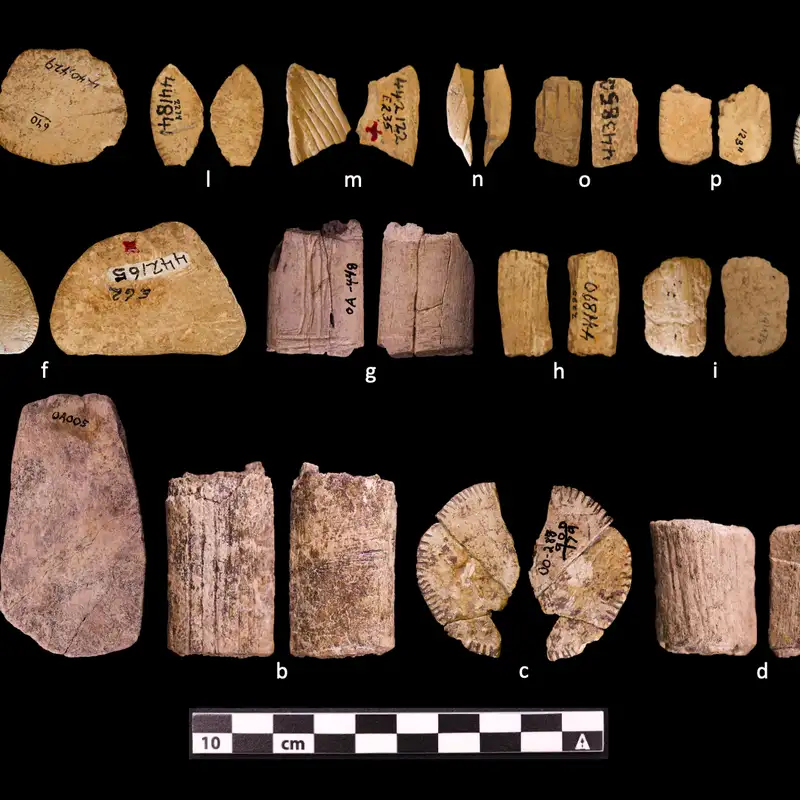
So, I searched through the archeological record; it was a very long process. I used online databases and libraries. It was like a treasure hunt, and I just kept looking for examples and keeping track of them. Finally, after about three years, I compiled the data set that makes up this paper and tracked this practice all the way from the well-documented historical era over the last 2,000 years as far back as I could. That's where we see this incredible persistence of this practice going all the way back to the Late Pleistocene – about 12,000 years ago – which is more than 6,000 years older than the earliest dice known in the Old World.
HOST: Now, the dice that we're talking about, again, are not the typical ones we think of today. What were they made of and what did they look like?
MADDEN: The test that I derived based on historical records is that they're almost entirely made of bone or wood. They're small enough to be held in the hands but sometimes they would be put in a basket and tossed. They have some very common features.
First of all, as I mentioned, they're two-sided. So, one of the two sides is always going to very recognizably fall upwards. They're marked on one side or another so that you can have a counting side or an upside. You might have carvings, or very commonly they would use color on one side, or paint, or burning.
They would fall into four categories of shape. Many of them would be flat, like a poker chip. Others would be flat on one side but round on the other. Think of it maybe as a short stick that you split in half and so it's going to be flat on one side and round on the other, and then they would mark either the round side or the flat side. Or you'd have ones that were round on one side like a stick, but they were hollow or concave on the other side, like if you had a piece of bamboo or cane, and you split it. You'd hold a group of them, and you'd throw them. Let's say you had five of them and you threw them and got two with the “upside” and three with the “downside.” So, you count the two upsides. Unlike, for instance, on a six-sided dice where the possible outcomes are 1, 2, 3, 4, 5, 6, you might throw five two-sided dice. You'd still get six possible outcomes, but those outcomes are going to be 0, 1, 2, 3, 4 and 5.
HOST: Now you mentioned the phrase gambling earlier, but this is not gambling the way that we think of it today, right? It was almost like a bartering system.
MADDEN: Yes, it really became an exchange system, and we really see good records of this in the historical record, and then we see it extrapolated into the prehistoric record. What we think of gambling is like at a casino where you bet against the house. And as we all know, any time you play against the house, the odds are always slightly tilted in favor of the house.
These games are one-on-one; there's no house. This is me against you. It's a fair game, everybody's got an equal opportunity, equal conditions, and it was used as a form of exchange, as you say, particularly between groups of people who did not come into frequent contact with each other, so they didn't really know each other. They didn't have pre-existing relationships because in traditional societies, that's how exchange works.
It's really a form of gifting over time that creates enduring reciprocal relationships. It's not about a commercial transaction where you and I are going to swap something and then go our separate ways. This allowed people that didn't know each other well to come together because they all understood the game and exchanged goods on a very fast basis without the need for those long-term relationships.
HOST: It's amazing that they all knew how to play the game, then. Were there different rules and different ways to play the game?
MADDEN: There were many ways. That's one of the things that's really very interesting is that, in fact, the rules were baffling to the Europeans who documented these games. They would come and watch the games, and the players would move so fast. There would always be two players and then there'd be a referee and scorekeepers. There would also be spectators gathered around. It was a very raucous affair. And there'd be all kinds of side betting going on.
The rules could be very complex, and they could be very different. But the basics of the game were very simple and very similar. So, as long as people felt that they understood the game well enough to understand that it was equal conditions for everyone, they could come together and play.
HOST: Who was playing these games? Was it kids playing, adults playing, men, women?
MADDEN: There's not really been any work done on that archeologically, but in the historical records with an ethnographic record where somebody wrote about seeing this game being played and described the gender of who was playing was about 70% women – women only, women exclusively. There were about 7% that were exclusively men. Then in the middle there was both men and women. Children could play, but it was generally done with adults.
So, you've got this really interesting, gendered component here, where at least in the historical period, it's predominantly a women's game. That raises some interesting questions that could be followed up in future research. I think the invention of dice really needs to be understood as both an intellectual achievement and a social technology that is unique.
HOST: Let's talk about that intellectual component. This is really a game of probability. So, you're introducing some pretty big concepts.
MADDEN: Yes, that's another thing that's really fascinating about this. People think dice is just a game. But what people don't realize is that when humans start making dice, that is the first evidence that we have of people engaging with and starting to understand concepts of randomness and probability. And not just understand it, but use it to create these equal conditions, to create a situation where people feel that they can relate equally to other people.
When we see the origins of dice, we're literally seeing the origins of probabilistic thinking. That's always been thought to have begun in the Old World, in the Bronze Age, about 6,000 years ago. This research shows that Native Americans were making dice, generating random outcomes and using those random streams of probability and harnessing them in games of chance 6, 000 years earlier. So, if we want to understand the history of probabilistic thinking, we now need to look into the Old World at the end of the last Ice Age.
HOST: That really changes how we think about a lot of things, I'm guessing.
MADDEN: It really does. It also tells us that in the past – and thankfully this is an idea that has ended up in the dustbin of history – there was this idea that Native Americans were somehow less intelligent. But this is an incredible intellectual accomplishment, something that's foundational to our modern understanding. It's foundational for statistics and quantum mechanics. Our entire modern scientific background is premised on this. And we've got Native Americans first exploring this in structured ways in the deep past.
HOST: And Native American dice have also been found locally, correct?
MADDEN: Colorado is absolutely a hotbed of ancient Native American dice. You find them throughout all historical periods. That's one of the neat things is that this isn't just something we found 12,000 years ago. We find these same dice with these same morphologies all the way throughout the historical record. Colorado’s Lindenmeier site – just north of here – is really the mother lode of Pleistocene dice.
There are 14 different partial or complete artifacts that fit the morphological test. These are from the Folsom period. These are from about 12,000 years ago at the Lindenmeier sites. The same time, the same kinds of objects also are being found up north in Wyoming at the Agate Basin site and down in New Mexico at the Blackwater Draw site. The interesting thing about Lindenmeier is that there’s a big question about whether it was an aggregation site, because it's huge. We wonder if this was a place where mobile bands that normally didn't see each other would come together once a year.
When we look at the archeological record much closer to modern times, that is where dice show up, in these aggregation sites. So, the fact that we have these dice showing up at Lindenmeier is some really good evidence that this was indeed an aggregation site. People were coming here from different locations, and they were using these dice as a way to interact with each other.
I got the chance to go to the Smithsonian and look at, photograph and examine the pieces from Lindenmeier and it was exciting to hold those pieces in my hand and feel like I'm looking at the origins of human understanding of probability.
HOST: These games that were played 12,000 years ago, are they still being played today, or is there an effort to bring them back?
MADDEN: Yes, it still exists. It has persisted. That's one of the remarkable things about this. Usually, if you see a practice from a few thousand years ago, it's exceedingly rare to see it continue. With dice, we're talking about a practice that we now know goes back to the late Pleistocene,12,000 years ago. These games are continuing. You can go on YouTube right now and find videos of groups getting together and playing these games.
HOST: Well, thank you so much for sharing this incredibly fascinating topic.
MADDEN: Well, thank you for having me.
OUTRO: That was CSU archeologist Robert Madden speaking about his recent research into early Native American dice games. I'm your host Stacy Nick, and you're listening to CSU's The Audit podcast.